The Matter of Magic: The Weight of Saliva (Part 1)

The Matter of Magic: The Weight of Saliva (Part 1)

💧 The Matter of Magic: The Weight of Saliva (Part 1)

In ordinary speech, words and physical acts are kept separate, but in the mechanics of Slavic magic, an exhalation, a spit, and a spoken word are isofunctional, dense currents of the exact same power. Here, a word does not merely vibrate in the air; it pours from the mouth like liquid, capable of being passed along, swallowed, or branded into the flesh. Saliva serves as a tangible vessel for the sorcerer’s knowledge, will, and very life essence.

🥃 The Bitter Legacy of the Vedzmar

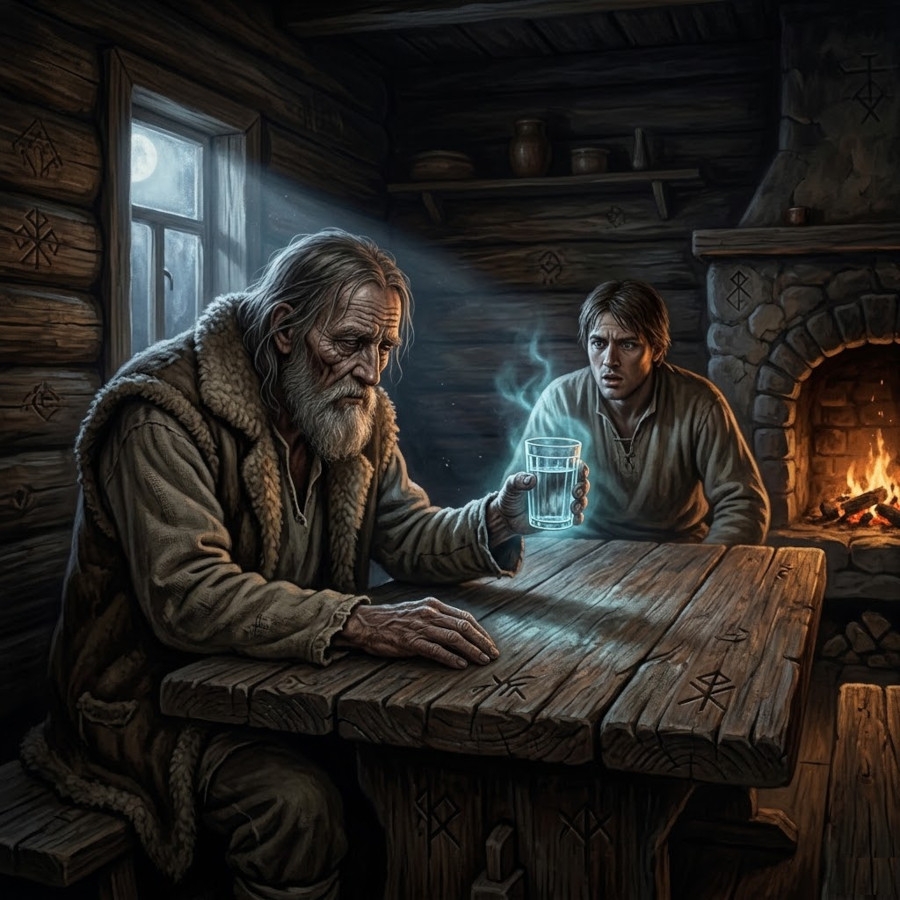
Passing down sorcerous power demands visceral, bodily contact. In Belarusian custom, a dying *vedzmar* (sorcerer), loath to take his crushing gift to the grave, pours a brim-full glass of vodka, whispers incantations over it at length, and spits into the drink, bidding his grandson to swallow this distilled essence. In the Russian North, the logic of this rite is framed with absolute clarity: in passing charmed water infused with her spittle, the *znakharka* (folk healer) “gave it all away with the spit; surrendered every word from her body.” In this act, knowledge is materially severed from its bearer.

🛁 The Absolute Boundary

At times, spittle bypasses the spoken formula entirely, cutting out the word to deliver the protective impulse directly. Among the Rusyns of the East Slovak village of Ubľa, an archaic rite shields the newborn: *”Do pershoho kupelya plyunuly”* (they spit into the first bathwater). The deed requires no vocalization; moisture charged with the bloodline’s intent instantly erects an invisible yet unyielding apotropaic ward around the infant.

🐍 The Kiss of Nav

Attaining unearthly wisdom demands an even harsher covenant and a direct trade of vital fluids. In Serbian tradition, a shepherd gains the gift of understanding the hidden language of nature (*nemušti jezik*) only through physical contact with the Snake King. The sovereign of the chthonic underworld orders the man to open wide and spits straight into his mouth, then demands the mortal reciprocate: three times they spit upon each other’s lips, sealing an indissoluble pact. Bulgarian folklore observes the same law: a prophetic serpent, keeper of the tongues of all beasts, can bestow its gift upon a human only by spitting directly into their mouth (*kato plyue v ustata mu*).

To be continued…

ꏍꏍꏍꏍꏍꏍꏍ

In the archaic mind, a magical spit is the ultimate materialization of intent. While a spoken phrase may scatter on the wind, transferred moisture welds sender and receiver at a physiological level—transmitting the very marrow of the spell and compelling the mortal vessel to house an otherworldly force.

👁 Think back to moments in your own life when a spoken pact or promise demanded a physical, bodily seal—in what unyielding modern rituals do you still trace this ancient urge to make the invisible word tangible?

#slavicmythology #ethnography #folkbeliefs #magic #znakharka
The Grim Compact: Warding Off Subterranean Vermin (Part 3)

The Grim Compact: Warding Off Subterranean Vermin (Part 3)

🐁 The Grim Compact: Warding Off Subterranean Vermin (Part 3)

The battle for a bountiful harvest and domestic peace is not fought solely against wolves and bears. A threat no less chthonic—and often far more insidious—creeps from below: the subterranean and household vermin, the mice, worms, and fleas. Their terrifying power lies in their multitude. To stem this living tide of decay, the Balkan Slavs raised defenses woven from incantations and unyielding spatial taboos.

🌾 The Mouse Quarantine of Mistrovdan

The day following St. Demetrius’ Day (November 8), as the earth braces for winter, marks the arrival of Mouse Day. The holiday bears a blended name—*Mistrovdan* or *Mištrovdan*—phonetically weaving the name of St. Nestor (November 9) with the Slavic *miš* (mouse). On this day, a merciless embargo is placed on anything the sharp-toothed intruders might gnaw. In the village of Strnovac, the matriarchs put it plainly: *“Не вадимо жито, не одимо во амбар. Не се сее жито… не пегламо”* (“We do not take out grain, we do not enter the barn. We do not sow grain… we do not iron”). Even opening linen chests is strictly forbidden. The household falls completely still, desperate not to provoke the destructive elements, deliberately stripping them of any contact with human belongings.

🧹 A Cast Lot

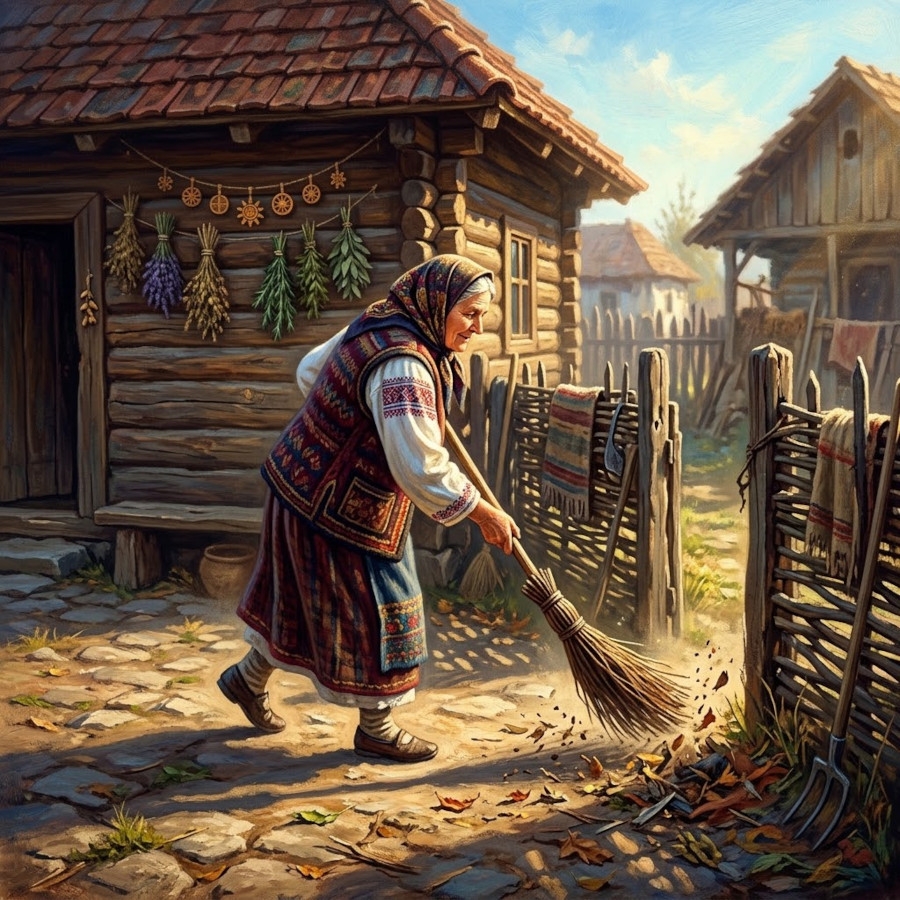
Household parasites like fleas are banished through more aggressive means: the spatial transference of defilement. On the morning after Christmas, a housewife in the village of Pelince sweeps her home with utmost care, steps out onto the terrace, and shouts across the fence toward a neighboring yard, calling out their name: *“Буви носи на комшију тога”* (“Carry the fleas to neighbor so-and-so!”). Tossing the unwanted—be it weeds or biting pests—onto another’s land is an ancient method of passing the blight. By cleansing their own threshold, the caster redirects the malevolent affliction to wherever defenses are weakest.

🔥 The Magic of the Sealed Word

A distinct ritual order is observed when dealing with worms, whom folk tradition considers direct kin to snakes due to their appearance and writhing gait. In the village of Mlado Nagoričane, on St. Barbara’s Day, villagers boil a mash of corn and wheat (*мешано: и пченка, и пченица*) meant to last for three full days. For the duration of those days, lighting a fire beneath the cauldron is an absolute taboo. The secret lies in the magic of language: the Macedonian verb *vrie* means both “to boil” and “to swarm / teem.” Peasant logic dictated: if you *boil* food, the earth will begin to *teem* with worms and creeping horrors. By placing an embargo on the word-action, humanity effectively arrests the breeding of the subterranean threat.

ꏍꏍꏍꏍꏍꏍꏍ

In the folk consciousness, warding off agricultural and domestic pests was never mere pest control; it was an intricate spatial and linguistic gambit. By sealing a quarantine around the granary, casting curses over the garden wall, or banishing dangerous trigger-words from speech, our ancestors carved an absolute sanctuary around their homes—a realm where the immutable laws of ritual proved far stronger than any lock and key.

🗝 How do you explain the enduring power of domestic superstitions, like the taboo against “taking out the trash after dark” or the dread of speaking ill omens aloud? In what modern rituals do you still catch glimpses of this ancient quarantine?

For further reading on the subject, see: A.I. Chivarzina, *“The Kumanovo Region at the Crossroads of Balkan-Slavic Traditions: Rites of Banishing Creeping Vermin and Wild Beasts.”*

#ethnography #folklore #slavicmythology #balkans #wards #traditionalbeliefs

A Stern Covenant: Scalded Scales (Part 2)

A Stern Covenant: Scalded Scales (Part 2)

🐍 A Stern Covenant: Scalded Scales (Part 2)

The spring awakening of the earth unseals the gates of Nav, unleashing *gady*—a creeping chthonic plague—into the waking world of Yav. This encroaching menace demands the immediate erection of magical borders. In the Kumanovo borderlands (the villages of Pelince, Dolno Konjare, and Mlado Nagoričane), the transition from spring to summer becomes an unbroken chain of rigorous ritual defenses against the serpent tribe.

🔥 The Scalded Double

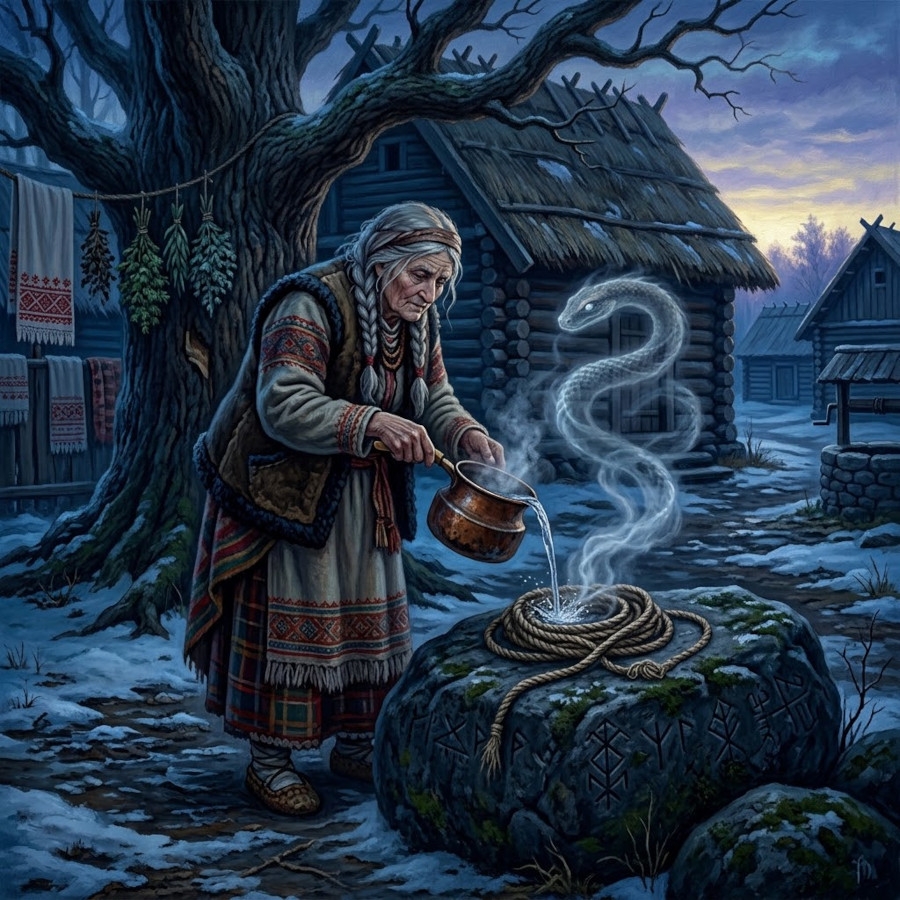
On the feast of the Prophet Jeremiah (May 14)—whom locals sometimes call *Aramija* (the bandit or thief), equating the serpent with a treacherous robber—housewives pass ancient judgment upon the beast’s symbolic body. Early in the morning, strictly before sunrise, a twisted cord or rope is laid upon a stone: a visual effigy of the serpent. The woman pours rolling boiling water over it straight from an ibrik, sealing the curse with an exacting formula: *”Parimo ti oči, usta, noge”* (“We scald your eyes, your mouth, your legs”). The physical injury dealt to the effigy transfers instantly to the original, blinding and paralyzing all snakes across the countryside. A similar cord-boiling rite is also performed on the feast of the Forty Martyrs (*Mladenci*) and on the first Saturday of Great Lent (*Todorica*).

🗣 A Stranger’s Name

South Slavic tradition dictates that every living person possesses a serpentine double in the wild bearing their exact name. To kill one’s own snake is to invite severe sickness or death upon oneself. Thus, in the village of Pelince, while scalding the rope, the housewife clutches her ears and shrieks a name three times at the top of her lungs. This name, however, must be foreign—completely unknown in the village—so that the sorcerous blow does not strike down any of her neighbors through their serpent twins.

⚔ Acoustic Terror

Come evening, the noisy phase of the banishment begins. The villagers seize fireplace pokers (*maša*) and violently beat against metal pots (*tendžere*), screaming into the dusk. The harsh clatter of iron and frenzied pounding mimic the imminent, ruthless vengeance of Saint Jeremiah upon the scaled fiends. Across the courtyards rings the incantation: *”Eremija u polje — zmija u more!”* (“Jeremiah to the field—the serpent to the sea!”). Iron, the stalwart bedrock of the human realm, literally cleaves through space, driving the creeping vermin far beyond the boundaries of settled land.

To be continued…

ꏍꏍꏍꏍꏍꏍꏍ

In traditional folk engineering, the struggle against serpents is never reduced to a primitive animal fear of venomous fangs; it is a profoundly complex manipulation operating through sympathetic magic. The peasant does not merely chase a beast with a stick. He strikes on an esoteric plane—deploying decoy targets, acoustic bombardments of iron, and surgical name-play to sever the threat without shattering the fragile balance between humanity and its natural reflection.

🌿 Does your family or homeland have its own traditions for keeping creeping threats at bay? What protective words, wards, or strict forest rules were handed down to you by your elders?

#ethnography #slavicmythology #folklore #serpent #folkbeliefs

A Stern Covenant: Offering to the Shaggy Master (Part 1)

A Stern Covenant: Offering to the Shaggy Master (Part 1)

🐾 A Stern Covenant: Offering to the Shaggy Master (Part 1)

In folk tradition, the winter forest is no place for idle strolls; it is an alien, predatory realm demanding rigorous diplomacy. At the crossroads of Serbia, Bulgaria, and North Macedonia—in the borderlands of Kumanovo—the boundary between the human homestead and the wild thicket is held not merely by fences, but by an ancient rite of survival.

🐻 The Bear’s Povojnica

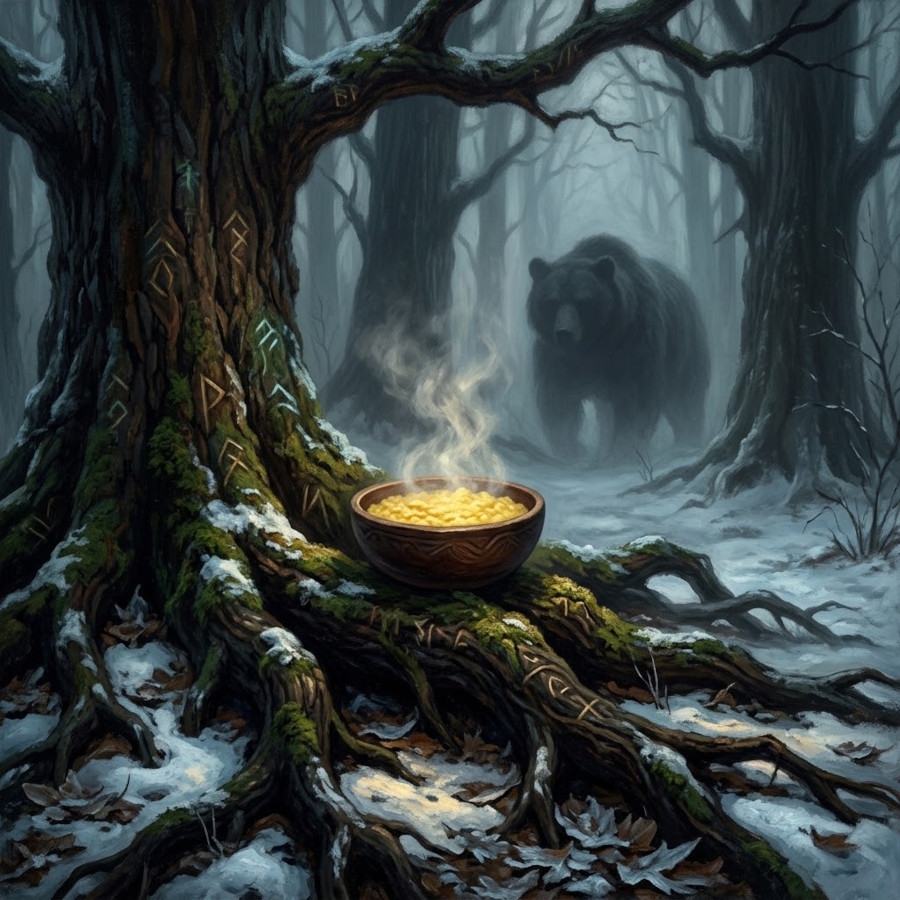
On January 14th, during the feast of Vasilica (Old New Year), Macedonian villages observe *Mečkina povojnica*—the day of bringing gifts to the newborn bear. The lore of the woods holds that in this bitter cold, the mother bear gives birth to her cubs, and man is bound to be the first to bring a celebratory birth-offering (*povojnica*). Housewives boil a hearty cornmeal porridge with cracklings—*varenica od mumuruz so čvarki* (or *mumuruznica*). Children carry the food out to the trees and recite the clear formula of the covenant: *”Će dojde mečka, ќe jede. Pa i mi da jademe”* (“The bear will come, the bear will eat. So that we may eat as well”).

Even in the lowland village of Pelince, where the forest master has long ceased to roam, memory of the custom endures: villagers symbolically celebrate “the bear’s birthday” to preserve the balance of power. And nearby, in the Serbian village of Jablanica, they bake a special corn pie for the woodland sovereign—*mečkin ručak* (“the bear’s dinner”).

🐺 The Sharp Jaws of Mratinci

A bit further north, the bear’s tribute is paid earlier, on Saint Andrew’s Day (December 13, *Mečkin dan/dən*). Here, a strict taboo on work takes hold: thread must not be stitched or darned, for a bear will surely tear apart anyone who dares enter the woods wearing garments mended on this day.

Yet before the shaggy beast settles into his den, the wolf claims his due. During the November *Mratinci* (the days surrounding St. Martin’s Day), weaving looms fall silent across the entire region, from Kriva Palanka to Kumanovo. Women hide away scissors and any sharp implements whose closing mimics the snap of a wolf’s jaws, and prepare ritual food. By binding the blades shut, humans magically bind the jaws of prowling predators, warding off misfortune from the flock for the entire winter.

To be continued…

ꏍꏍꏍꏍꏍꏍꏍ

The ritual feeding of the beast in the winter cold reveals not naive generosity, but the cold pragmatism of our ancestors: acknowledging the might of a chthonic neighbor and paying a tax on life itself. By sharing food with the woodland lord at the hour of his birth, man weaves himself into the natural cycle not as prey, but as an equal partner in a stern covenant.

🌲 Think of moments in your own life when you had to “placate” an unpredictable element, temperamental machinery, or insurmountable circumstances just so they would let you get the job done in peace. What does your modern “offering to the master” look like?

#ethnography #slavicmythology #balkans #bear #folklore

“A Doll from a Stolen Broom…” Stolen Power (Part 4 of 4)

“A Doll from a Stolen Broom...” Stolen Power (Part 4 of 4)

🧶 “A Doll from a Stolen Broom…” Stolen Power (Part 4 of 4)

🧹 The Unwitting Donor

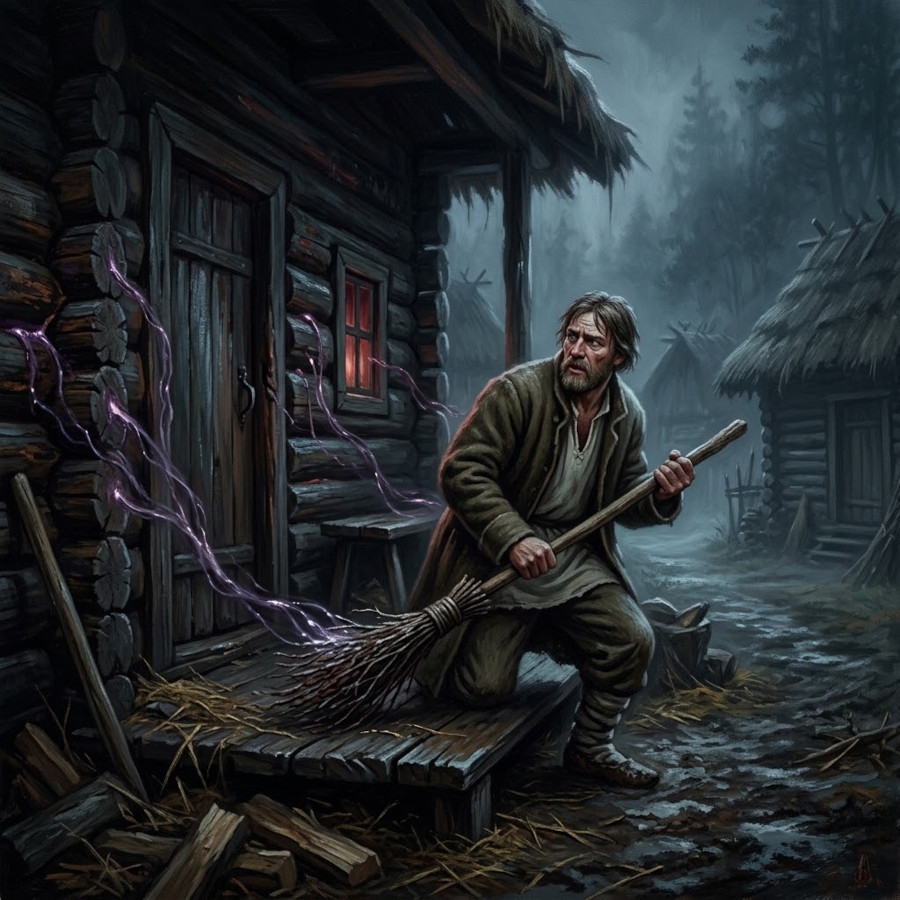
In the realm of archaic myth, a person can become a vital nexus of a ritual without ever suspecting it. Here, they occupy the role of a medium: an individual whose latent magical potency is harnessed by others through misappropriated belongings. In the Bulgarian rainmaking rite, for instance, villagers would covertly steal a broom from a pregnant woman’s courtyard to fashion the ritual effigy of “German.” The woman herself was physically absent, yet the formidable fertility locked within her body was forcibly channeled into the sorcerous working through the stolen object.

🧶 The Magic of Another’s Fate

Millennia of folk wisdom show that a distinct social status—or even a name—can turn a human being into a living artifact. To protect a newborn, Serbs in Kosovo stitched swaddling clothes exclusively from yarn gathered from nine widows; in other regions, they wove a sash from the wool of nine women named Stoja. An infant might also be wrapped in the father’s shirt to pass down paternal virtues and forge an invisible armor against misfortune. The destinies, names, and standing of these people served as raw materials, cut and tailored into a new *dolya*—a fresh lot in life—for the one entering the world.

🏺 Cast into the Abyss

Ritual logic leaves no doubt: objects belonging to people of liminal status hold the power to breach a natural anomaly. In Polesia, during severe droughts, peasants sought salvation for the land by casting pots stolen from a potter, an outsider, or a neighbor down a well. By seizing an item from someone bound to the firing of clay or to an alien way of life, the community turned them into a blind conduit—one whose channeled energy, bound to the sunken vessel, forced the subterranean waters to rise.

ꏍꏍꏍꏍꏍꏍꏍ

Employing another’s possessions in magic is no mere symbolic gesture; it is the theft of raw, operative potential. A pregnant woman, a potter, or a widow acts as a living battery charged with a specific essence: fertility, an intimacy with the earth, or the profound gravity of loss. In claiming their broom, yarn, or clay pot, the ritual practitioners physically sever a piece of another’s status and integrate it into their own mechanism. The human medium is doubly stripped of agency: they neither perform the act nor serve as its target, yet it is their latent power that turns the gears of the entire rite.

👇 Have you ever felt a strange, inexplicable emptiness after a personal belonging—a piece of clothing, a tool, or jewelry—fell into another’s hands without your consent, as if a fraction of your unseen vital reserve had been siphoned away with it?

For further reading on the subject: S. M. Tolstaya, *The Human in Ritual: Subject, Object, Addressee, Medium*.

#folklore #ethnography #slavictraditions #magic #rituals