
🌑 Four Guardians of the Izba: Boundaries of the Human World (Part 3)
In traditional folk topography, the four corners of an *izba* are far more than mere geometry: they are four load-bearing pillars holding back the onslaught of chaos. A home bounded by four corners is conceived as an ordered, sanctified space—a steadfast bulwark against evil. To be stripped of one’s corners is to lose all protection: in ancient laments, collapsed corners symbolize the ruin of the household and the arrival of death. And so, at this very threshold—where the human world wears thin and bleeds into the Otherworld—the fiercest magical warfare takes place.
👁 The Abode of the Unseen
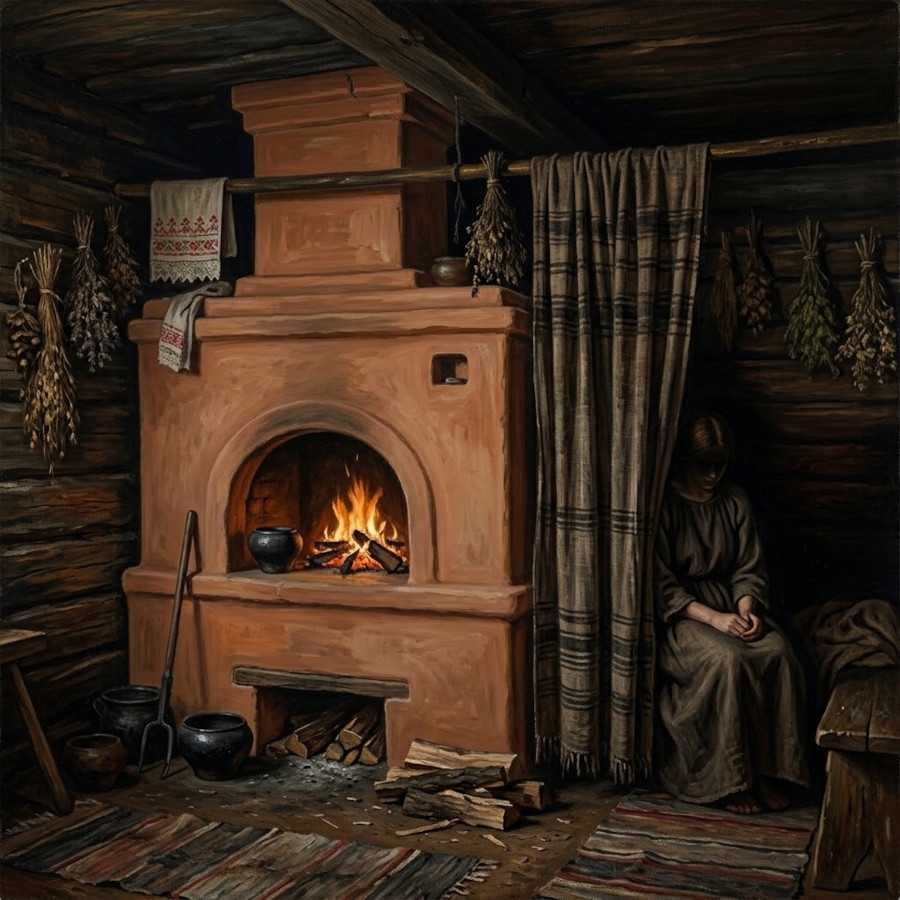
The corners of a dwelling form its outermost periphery, a favored haunt for spirits and chthonic visitors. Here nests the *domovoy*: to pacify a rampant house spirit, Belarusians fumigate the corners with poppy seeds and deliver a stern decree: *”Domovoy, go to your home, for this house is mine.”* Yet beyond the “master of the house,” corners draw far darker, unclean forces. In the Arkhangelsk region, it is known: fail to sprinkle holy water into the corners of outbuildings at Epiphany, and *sholyshny*—sinister Yuletide imps—will take up residence there. According to beliefs in Tambov, witches breed their demonic familiars, *kolovertyshi*, by tucking the afterbirth of a whelping bitch into the far corner beneath the stove. Even seasonal spirits are drawn to this locus: in the Gomel region, tales tell of a *rusalka*, lured into a house with a consecrated sash, who stood silently in the corner of the izba for an entire year.
☠ Purging Defilement and Strikes from Without
As the point furthest from the center, the corner becomes a site for magical disposal. Here people pour out the water used to wash a corpse, toss the soap, coffin shavings, and severed elf-locks (*koltun*)—anything that must forever depart the land of the living. Aware of this boundary’s vulnerability, black sorcerers direct their strikes precisely at the corners. Belarusians believe cattle plagues strike if a devil or sorcerer buries a “dried egg” beneath the corner of the barn. In Zhytomyr, a death curse is laid by burying grave sand, charcoal, and bones in the four corners of a cottage: *”and no one will live there—all will perish.”* A malevolent carpenter can doom a new build by striking the butt of his axe against every corner, chanting: *”As many corners as there be, so let there be corpses”* (Vitebsk region).
⚔ Sealing the Thresholds
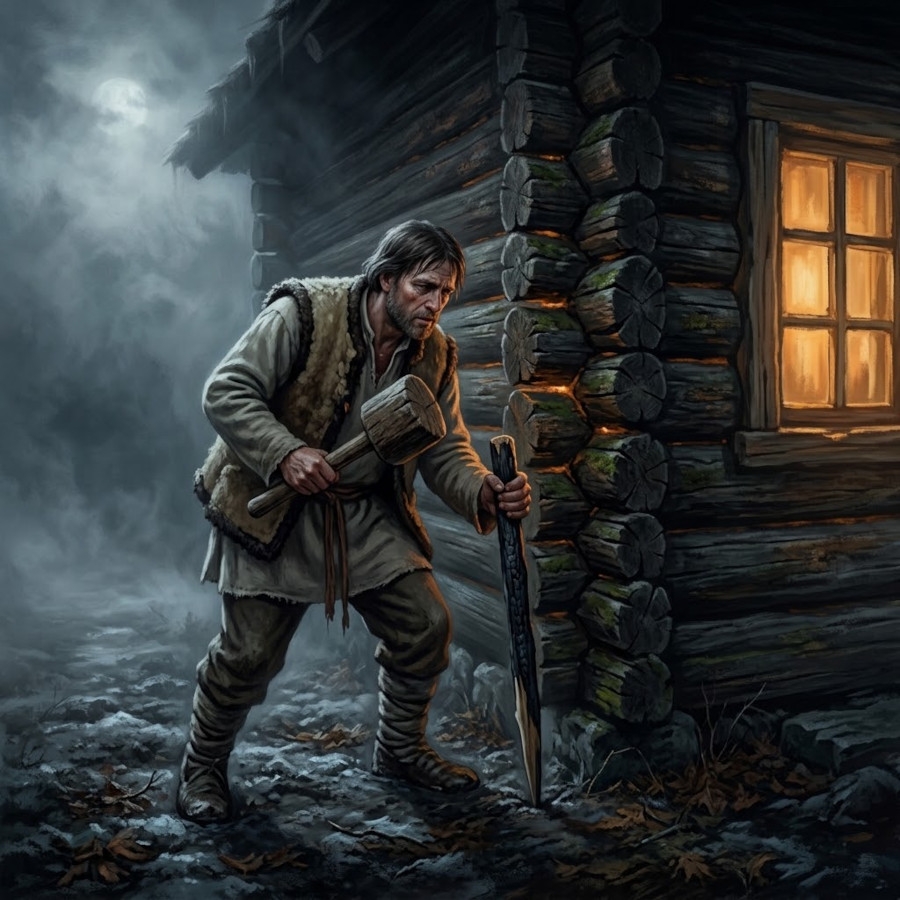
To safeguard the perimeter, the Slavs raised an impenetrable defense around both exterior and interior corners. On Maundy Thursday and Epiphany, they marked the corners with crosses using chalk, charcoal, or soot from a Passion candle, ensuring neither lightning would strike nor a demon enter. In Gomel, Belarusians expelled malevolent spirits with an ancient formula: *”Fall back, foe, from the four corners, and from the fifth—the door.”* And if a restless corpse began to “walk” and haunt its kin, the folk of Polesia (in the village of Zabolotye) resorted to drastic measures: driving aspen stakes into the ground at the four outer corners of the house, firmly sealing the perimeter of Yav—the realm of the living—against intrusions from the dead.
ꏍꏍꏍꏍꏍꏍꏍ
In the archaic engineering of space, the four corners are the seams of the cosmos. They bind together the fragile timber-frame of human existence, yet it is precisely here that the fabric of reality is sheerest and most porous. When leaving an offering for the domovoy, driving an aspen stake, or tracing a cross in candle soot, the peasant was not indulging in mere decoration—he was standing watch on the border, physically suturing his world so that primeval darkness would not flood in.
🕯 Tradition has instilled in us an instinctive wariness of sitting “at the corner,” and in the dark of an empty room, our gaze drifts unbidden toward the corners, scanning for lurking threats. How do you explain this visceral unease, and is there a “dark corner” in your home that still stirs an uncanny sense of dread?
For further reading on the subject: T. A. Agapkina, *The Symbolism of Reclaimed Space: The Corner* (*Символика освоенного пространства: Угол*)
#ethnography #slavicmythology #folklore #izba #wards