
Bloodline Engineering: Axis of the Cosmos (Part 2)

Bloodline Engineering: Axis of the Cosmos (Part 2)

🕯 Bloodline Engineering: Axis of the Cosmos (Part 2)

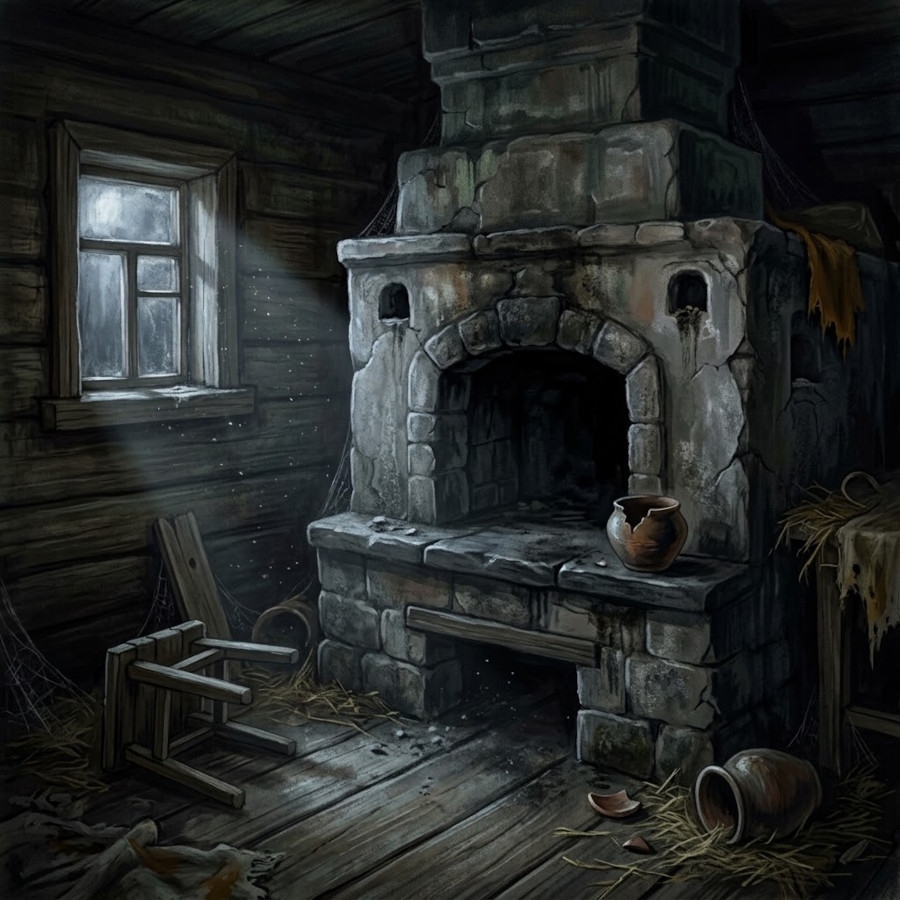
If the man in Slavic domestic architecture holds the outer frontier, it is the mother and wife who forge its inner gravity—the very axis of the cosmos. In the funeral laments of the Eastern Slavs, the loss of a mother is never merely personal grief; it is the ontological collapse of the home itself. Bereft of her, physical space instantly loses its sacred meaning: the house turns dark, deaf, mute, and *pustyly*—barren and desolate, as they say in the Russian North.

🏚 The Chilled Firmament

Ukrainian lament traditions capture a chilling spatial rupture: having returned from the burial, the daughter wails that she leans against the wall, yet it no longer gives warmth; the house appears unchanged, yet offers no solace. A devastating formula of ruin resounds: *“Ta y ta khata, y ta strikha [roof], ta u khati ne ta utikha”* (“The house is the same, the thatched roof is the same, but the solace within is no more”). The stove still stands, but speech has died around it; the thresholds remain, but conversations will cross them no longer. Deprived of its mistress, the home collapses back into an alien, hostile matter, powerless to shelter the orphan.

🗣 The Secret Word

The mother serves not only as spinner, reaper, and nurturer, but as the primary conduit through whom the lineage’s apotropaic, protective force circulates. In the Russian North, she is revered as the *tayna razgovorchitsa* (“secret confidante”) or *dumshchitsa* (“keeper of counsel”), and her speech as the *taynoye slovechushko*—the “intimate whispered word.” These are not idle fireside chats. This is a closed, sacred channel barred from outsiders, through which the mother dispels tension, soothes pain, and passes down hidden wisdom. To lose a mother is to lose that one irreplaceable “secret word” capable of sealing away sorrow and piecing a shattered world back together.

⚖ Truth Incarnate

In the Ukrainian and Belarusian traditions, the mother’s status is elevated to an absolute ethical law—she is wholly identified with *Pravda* (Cosmic Truth and Righteousness). Daughters cry out over the deceased: *“Moya nenko… moya pravdonko virnesenka!”* (“My dearest mother… my truest, most faithful Truth!”). Here, the mother stands as the supreme arbiter of justice and blood-deep sincerity. Orphaned children voice the cosmic catastrophe: *“My vzhe vid nikoho ne budem maty pravdy”* (“Never again will we find truth from anyone”). To lose a mother is to lose the sole wellspring of absolute, unshakeable truth in a world where everyone else is an alien wilderness—*chuzhaya chuzhina*.

To be continued…

ꏍꏍꏍꏍꏍꏍꏍ

The loss of a mother in the Slavic worldview is a fundamental fracture of space itself. She generates the unseen substance that turns the dead timbers of a log cabin into a sacred, fortified Frontier. Once she is gone, the *khata* immediately collapses into primeval chaos—bereft of warmth, stripped of the “secret word” and higher “truth”—leaving the soul face-to-face with the howling drafts of the Abyss.

🗝 Recall moments from childhood or adulthood when the physical presence of a single person instantly transformed the very fabric of space from hostile to utterly safe. Through what unseen, seemingly mundane domestic details is this living “axis of the cosmos” woven within your own home?

#ethnography #slavicmythology #folklore #mother #laments
SERBIAN WEATHER MAGIC: Part 3/3

SERBIAN WEATHER MAGIC: Part 3/3

SERBIAN WEATHER MAGIC: Part 3/3

The Celestial Watch: Zduhaći and the “Devil’s Voivodes”

Hail, kin! This is the final chapter of our Balkan chronicle. We have spoken of how common folk defended their fields. But there were those for whom war against the skies was destiny. In the rugged mountains of Serbia and Montenegro lived people whose souls knew no peace.

These were no fairy tales. For the villagers, this was as real as the sunrise.

😴 Zduhaći: Men with the Shadow of a Dragon

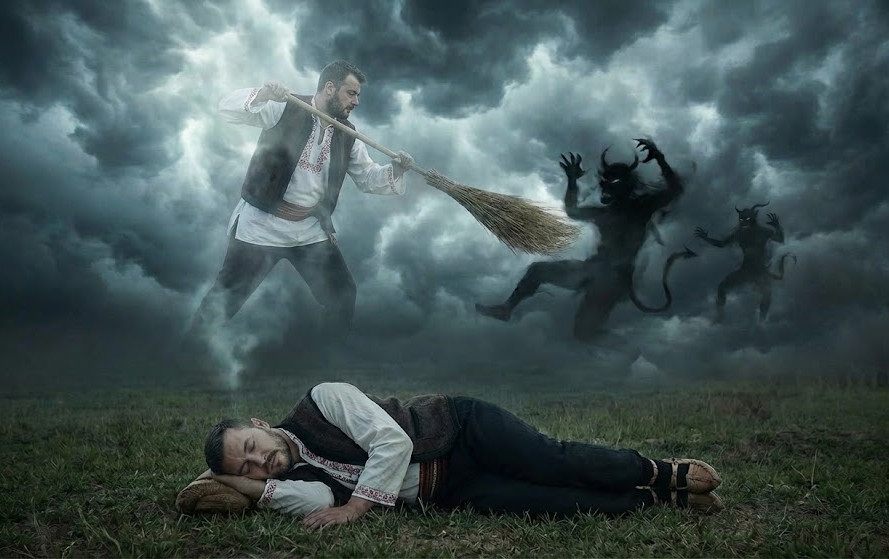
In Montenegro and Herzegovina, people knew: walking among the shepherds and plowmen were the *zduhaći* (or *vetrogoni*—the “wind-chasers”). By day, such a man seemed unremarkable—often sullen, brooding, perpetually drowsy. But when the skies turned to lead and the gale gathered, his face changed. He heard the call. The *zduhać* would collapse wherever he stood, sinking into a death-like slumber. He must never be awakened—his body was left empty, and should it be disturbed, his soul might never find the way back.

While the flesh slept, his spirit-double surged up into the storm clouds. There, a titanic battle unfolded. The *zduhaći* of one village formed warbands to clash against foreign *zduhaći*. In the heavens, they battered one another not with swords, but with whatever fell to hand, magnified to colossal proportions: uprooted ancient oaks, millstones, massive barrels. Yet their deadliest weapons were brooms and shovels. Whoever managed to wrest a broom from an enemy in this astral brawl carried off good fortune and the harvest for their own village. Upon waking, the *zduhać* often could not even stand—his entire body bruised and aching, as though he had spent the whole night hauling stone.

👹 Trivun, the “Devil’s Voivode”

In Eastern Serbia, the “cloud-chasers” (*gradobranitelji*, or hail-defenders) fought wide awake, throwing themselves into a battle trance. Trivun Selenić from the village of Kamenica became a legend. The villagers called him the “Devil’s Voivode” (*Đavolji vojvoda*). At the first sight of a storm cloud, he would bolt into the fields, trembling violently, his eyes rolling back into his head. He bellowed eerie, rhythmic commands into the sky in a language no one else understood: *”Raviše đaviše, naviše, kuriše!..”* He did not plead. He commanded demons. Sweeping his arms through the air, he wheeled celestial battalions: “To the right! Fall back, to the Danube!” And the clouds obeyed their general.

🏃‍♂️ The Sacred Madness of Nikola

Another guardian, Nikola Stojković, fought differently. At the first roll of thunder, he would tear off his cap—a sign of total surrender to the unseen forces—and charge straight toward the tempest, shredding his clothes and skin against the briars. He hurled crumbs of the Christmas bread (*česnica*) into the sky, and standing beneath the deluge, carried on a dialogue with the spirits of the hanged, alternately begging them and threatening them in the name of God.

💃 Padalice: The Soul Beyond the Body

The women were no less formidable. The *padalice* (women afflicted with the “falling sickness,” or epilepsy) were revered as exceptionally powerful protectors. A seizure during a storm was seen not as an ailment, but as the moment of clash: their souls took flight to lock horns with the *halas* (the storm demons). Meanwhile, the seeress Stana Tomić simply stepped out onto her threshold and talked to the sky as though scolding a bad neighbor, discerning the specific dead souls driving the storm: “Hey, Radomir, turn your horses back! No feast is laid for you here!”

These people were the living shield of the community. Outcasts and the chosen all at once. Folk avoided them, whispering of sorcery, yet come harvest time, it was to their doorsteps that the first sheaves and finest offerings were brought. For everyone knew: while the village slept, they were fighting in the heavens for every single ear of grain.

ꏍꏍꏍꏍꏍꏍꏍ

👇 The phenomenon of the *zduhać* describes a person with hidden depths: outwardly quiet, lethargic, and unassuming, yet holding a wild, elemental power that awakens only in the hour of danger. Have you ever crossed paths with such “sleeping volcanoes” in real life—people who seem completely passive in daily life, but when crisis strikes, step up and take control of the chaos while everyone else panics? Or perhaps you recognized yourself in this description?

For further reading on the topic, see: N.I. Tolstoy, *Essays on Slavic Paganism*.

#slavicmythology #slavicfolklore

WEATHER MAGIC AMONG THE SERBS: Part 2/3

WEATHER MAGIC AMONG THE SERBS: Part 2/3

WEATHER MAGIC AMONG THE SERBS: Part 2/3

The Dead, Swaddling Clothes, and Tricking the Calendar

Continuing our journey through the lore of Serbian magic. Weapons and food are merely the first layer. Deeper still lies an intimate bond with the ancestors and sacred time.

👻 The Call to the Drowned

In the Dragačevo region, people believed that storm clouds were driven by the *pogibalci*—those who died an unnatural death, such as the drowned and the hanged. They were said to herd celestial flocks. Because of this, women would step outside and cry out, addressing deceased villagers they had known by name: “O Radojko Zimonja! Turn back your bulls… Do not let them trample our grain!” Or they would summon Stojana, a drowned woman: “Turn back the herd, Stojana!”

👶 Magic of the Hearth: Weddings and Birth

Objects tied to liminal rites of passage (birth, marriage, death) possessed immense protective power:

🔸 Funerary: People would wave the chin-cloth once used to bind a corpse’s jaw, or a banner taken from a grave.

🔸 Bridal: Young brides brought out their wedding wreath and veil. Waving the wreath toward the sky, they would chant: “I was wed with this wreath (*venac*)… go, [hail], along the mountain crest (*venac*)!” This relies on a play on words: in Serbian, *venac* means both a wreath/crown and a mountain ridge.

🔸 Natal: A cradle containing an infant was set out in the yard. Swaddling clothes and binding bands were brandished against the sky. Incantations often invoked an impossible wonder: “A maiden of seven years gave birth… and covered the fields with her swaddling cloths.”

📅 Calendar Armor

The Serbs channeled the latent power of major feast days:

➤ Christmas: A fragment of the ritual Christmas bread (*česnica*), straw, and even hearth ashes from Christmas Eve were preserved throughout the year. They were brought outside and burned before an advancing cloud. In some villages, women hurled dough pellets made at Christmas high into the sky.

➤ St. George’s Day (*Đurđevdan*): Small crosses were fashioned from hazel wood and driven into fields and rooftops before sunrise. Hazel was considered a sacred tree immune to lightning strikes.

➤ Trinity Sunday: Special three-in-one candles were crafted, lit on the feast day, and then kept in reserve to ward off hailstorms.

➤ Easter: The first dyed egg (the *čuvarkuća*, or “house guardian”) was buried in the vineyard or held aloft to confront falling hail.

🤥 The Great Deception

A storm cloud could also simply be outsmarted. In Goračići, women would shout across the hills to their neighbors: “O, Stanija! What day was St. George’s Day?” Stanija was expected to lie: “Two days earlier!” It was believed this deliberate falsehood would disorient the cloud, causing it to lose its way and disperse.

ꏍꏍꏍꏍꏍꏍꏍ

👇 The Serbs used everything held sacred for protection—from bridal veils to Christmas breadcrumbs. Do you keep an heirloom at home from a major milestone (a wedding, an anniversary) not just as a keepsake, but as a kind of talisman, believing that the “power” of that day still lives within it?

For further reading: N. I. Tolstoy, *Essays on Slavic Paganism* (*Ocherki slavyanskogo yazychestva*).

#slavicmythology #slavicfolklore

WEATHER MAGIC AMONG THE SERBS: Part 1/3

WEATHER MAGIC AMONG THE SERBS: Part 1/3

WEATHER MAGIC AMONG THE SERBS: Part 1/3

🌩 Iron, Shouts, and Bread-and-Salt: The First Line of Defense

When a black storm cloud gathered over a Serbian village, the peasant knew: the “white cattle” (the celestial herd) were coming, driven across the sky by demons or the unquiet dead. In Dragačevo, hailstorms were met fully armed.

⚔ The Cleaving: Battling the Sky

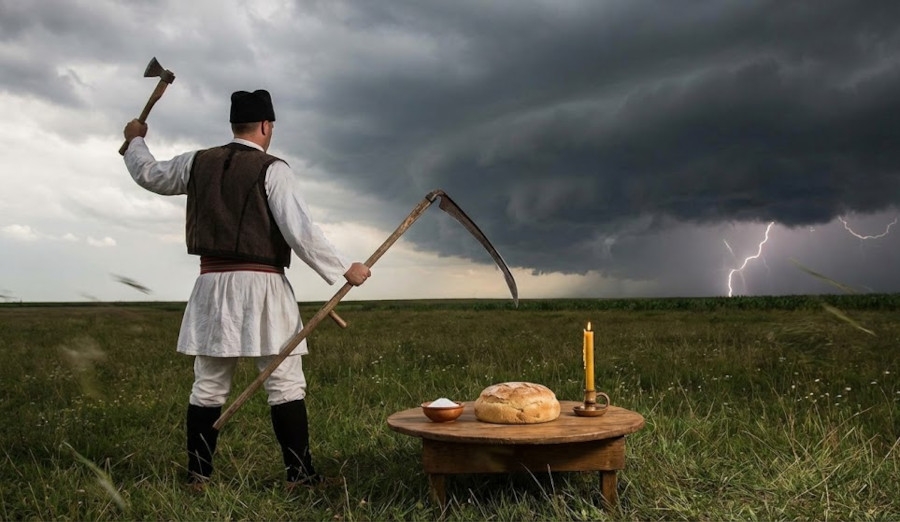
The peasant’s primary weapon against hail was sharp iron. Axes, scythes, sickles, and hoes were all brought into the fight. In the village of Goračići, mowers caught in the open fields would remount their scythe blades backwards and slash them at the storm cloud, believing this could “cleave” the hail apart. Axes were hurled directly into the sky or struck deep into the earth, edge pointing upward, to “cut the hail in two.” In Guberevci, men brandished their scythes and chanted: “Hey, storm cloud, do not strike the mowers!”

Wooden weapons were used as well. There was a specific staff known as the *ustukač* (from *ustuk*—”retreat”). This goad, normally used to drive oxen, was shaken at the sky with a fierce cry: “Turn back, little bull, keep your white cattle penned!”

🦷 Teeth and Nakedness

If hail broke through anyway and began to batter the fields, the peasants turned to the magic of the body. One had to snatch up the very first hailstone and swallow it whole, or bite it cleanly in two. In Takovo, folk believed this act alone would make the hail cease at once. This task was often entrusted to children: either the *neporođeno dete* (the family’s youngest child) or the firstborn.

To terrorize the cloud itself, the women of Dragačevo would run circles around the house naked, or with their skirts hoisted high. In the village of Rogača, women stripped bare, dashed around the homestead, and screamed toward the heavens: *”Okolo, bogo! Bokom, божок!”* (“Turn aside, god! Pass by our flank, little god!”). Ritual nakedness was believed to terrify and repel the supernatural storm.

They also fought the sky with deafening noise: firing rifles and *prangije* (small mortars), striking empty watermills, and deliberately provoking bulls to roar and swine to squeal.

🍞 The Offering: A Feast for the Demon

When violence failed, the villagers sought appeasement. This was the ritual of “hospitality.” A low dining table—a *sofra*—was carried out into the yard, set with bread and salt, accompanied by spoons and forks.

The centerpiece of this offering was the *Slavska sveća*—the sacred candle blessed during *Slava*, the feast of the family’s patron saint. Preserved carefully throughout the year, it was lit before the gathering darkness as an appeal to the ancestral holiness of the clan. Sometimes an Easter egg and ritual Christmas bread were placed upon the table as well. In Goračići, the peasants shouted into the gloom: “Bread and salt for us, but the table is bare for you, Stanko the Drowned!”, casting out the uninvited guest.

ꏍꏍꏍꏍꏍꏍꏍ

👇 Here we witness two stark extremes: either assaulting the elements with cold steel and wrath, or laying a feast and meeting the tempest with bread and salt. Which approach do you think was psychologically more effective for people of old facing terror: venting their aggression (slashing the sky with scythes), or performing an act of humility and communion (bringing out the bread)?

For further reading on the subject, see: N. I. Tolstoy, *Essays on Slavic Paganism* (*Ocherki slavyanskogo yazychestva*).

#slavicmythology #folklore

Bloodline Engineering: Keeper of the Frontier (Part 1)

Bloodline Engineering: Keeper of the Frontier (Part 1)

🪓 Bloodline Engineering: Keeper of the Frontier (Part 1)

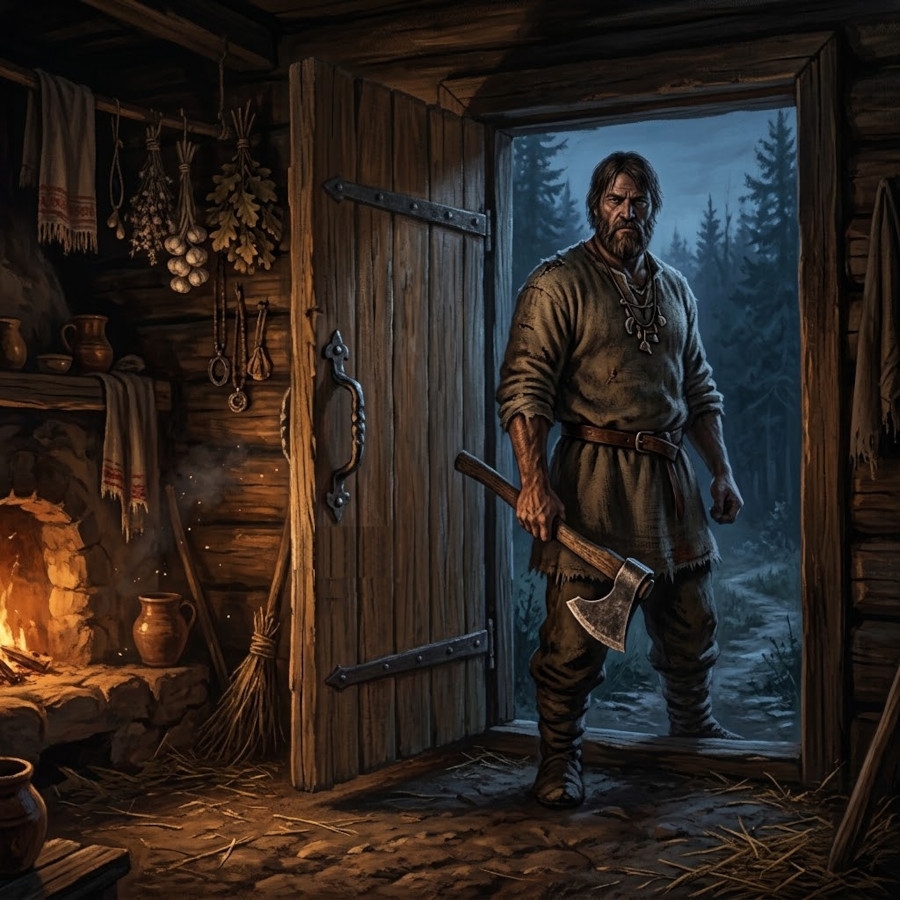
In Slavic funeral laments, the family is no sentimental circle of kin, but a rigid, functional survival machine. Here, each member of the clan is judged not by abstract warmth of soul, but by the specific breach they seal in the homestead’s defenses. And the male figure—husband and father—stands as the absolute organizing core of this system: the keeper of its outer frontier.

💪 The Master-Steward

When a widow mourns her husband, she mourns the collapse of a load-bearing pillar. In East Slavic laments, a good husband is, above all, a tireless plowman and an overseer. Death is recorded through a formula of catastrophic void: in the Russian North, mourners wail that now “there is no plowman in the open field, no woodcutter in the dark forest.” In Belarusian laments, the orphaned yard asks who will now “plow the field” (*niwku arats*), “scythe the hay” (*sena kasits*), and “watch over the threshing barn” (*humno pahlyadzits*). Meanwhile, a Ukrainian widow evokes her departed husband concisely through labor: *“Oy, my little scythesman, my little plowman!”* (*“Oy myy kosaryku, myy ratayiku!”*), *“My provider, my procurer!”* (*“Moy dostavalnychku!”*).

🛡 A Bulwark Against Driving Rain

The chief virtue—both magical and physical—of the householder is his ability to establish order and shield his own. In Northern Russian lamentations, the father-protector is likened to a fortress, hailed as the “city wall” (*stena gorodovaya*) and “our dear defense” (*nasha oboronushka*). A widow weeps that she has lost her “shelter from the pouring rain” (*ot chasta dozhdya zatulushki*). This same piercing metaphor echoes in Ukrainian laments from the Poltava region: *“My husband, my shield! I hide behind you and fear no one”* (*“Miy cholovyche, miy zatulo! Ya za tebe zatulyusya tay nikoho ne boyusya”*, from the verb *zatulyty*—to shield, to cover). The man is the physical bulwark behind which the kinfolk take refuge.

⚖ Our Counsel and Command

Beyond physical defense, the master of the house upholds the *uryad*—the ordained order of things. In Ukrainian and Belarusian texts, the core concepts are *rada* (counsel) and *poryadok* (order and governance). The deceased is addressed as “our counsel and guidance” (*“nasha rada y porada”*) or “my dear steward of order” (*“paradnichak ty moy mily”*). The need for this firm male rule was so profound that even over an infirm husband unable to do heavy labor, a widow would lament: *“And you, though you did no toil, gave counsel… you commanded me, and I worked, and all was well…”* A man might not plow the soil himself, but he was duty-bound to *command*, keeping the world from unraveling into chaos.

To be continued…

ꏍꏍꏍꏍꏍꏍꏍ

In mourning a husband and father, the Slavic woman mourns the loss of the will that kept chaos at bay. In this archaic engineering, love was not expressed through idle sighs on a bench, but through shared, finely tuned, relentless labor. To lose the *bolshak*—the master of the hearth—meant facing a hostile world alone, stripped of shield and compass alike.

🗝 Recall a time when a person in your family or circle—even without performing grueling physical labor—held the entire fabric of life together through sheer presence and commanding spirit. What do you think underpins this invisible authority in modern families?

#ethnography #slavic_traditions #folklore #family #funeral_laments