
A Stern Covenant: Offering to the Shaggy Master (Part 1)

A Stern Covenant: Offering to the Shaggy Master (Part 1)

🐾 A Stern Covenant: Offering to the Shaggy Master (Part 1)

In folk tradition, the winter forest is no place for idle strolls; it is an alien, predatory realm demanding rigorous diplomacy. At the crossroads of Serbia, Bulgaria, and North Macedonia—in the borderlands of Kumanovo—the boundary between the human homestead and the wild thicket is held not merely by fences, but by an ancient rite of survival.

🐻 The Bear’s Povojnica

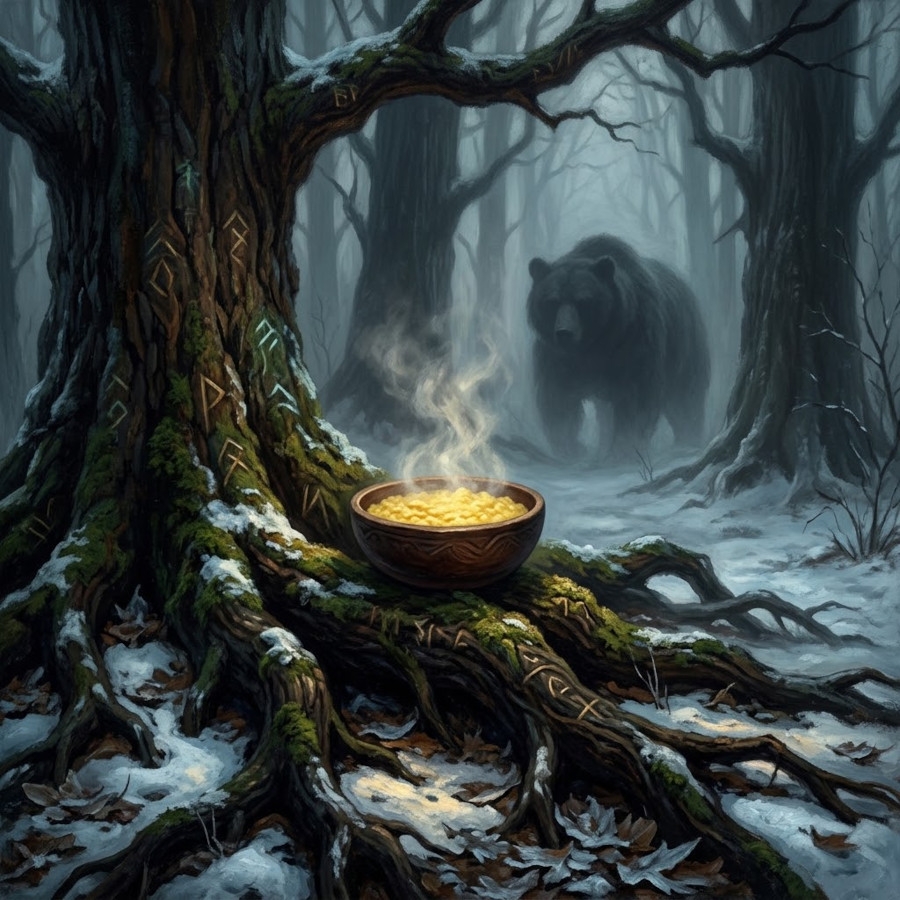
On January 14th, during the feast of Vasilica (Old New Year), Macedonian villages observe *Mečkina povojnica*—the day of bringing gifts to the newborn bear. The lore of the woods holds that in this bitter cold, the mother bear gives birth to her cubs, and man is bound to be the first to bring a celebratory birth-offering (*povojnica*). Housewives boil a hearty cornmeal porridge with cracklings—*varenica od mumuruz so čvarki* (or *mumuruznica*). Children carry the food out to the trees and recite the clear formula of the covenant: *”Će dojde mečka, ќe jede. Pa i mi da jademe”* (“The bear will come, the bear will eat. So that we may eat as well”).

Even in the lowland village of Pelince, where the forest master has long ceased to roam, memory of the custom endures: villagers symbolically celebrate “the bear’s birthday” to preserve the balance of power. And nearby, in the Serbian village of Jablanica, they bake a special corn pie for the woodland sovereign—*mečkin ručak* (“the bear’s dinner”).

🐺 The Sharp Jaws of Mratinci

A bit further north, the bear’s tribute is paid earlier, on Saint Andrew’s Day (December 13, *Mečkin dan/dən*). Here, a strict taboo on work takes hold: thread must not be stitched or darned, for a bear will surely tear apart anyone who dares enter the woods wearing garments mended on this day.

Yet before the shaggy beast settles into his den, the wolf claims his due. During the November *Mratinci* (the days surrounding St. Martin’s Day), weaving looms fall silent across the entire region, from Kriva Palanka to Kumanovo. Women hide away scissors and any sharp implements whose closing mimics the snap of a wolf’s jaws, and prepare ritual food. By binding the blades shut, humans magically bind the jaws of prowling predators, warding off misfortune from the flock for the entire winter.

To be continued…

ꏍꏍꏍꏍꏍꏍꏍ

The ritual feeding of the beast in the winter cold reveals not naive generosity, but the cold pragmatism of our ancestors: acknowledging the might of a chthonic neighbor and paying a tax on life itself. By sharing food with the woodland lord at the hour of his birth, man weaves himself into the natural cycle not as prey, but as an equal partner in a stern covenant.

🌲 Think of moments in your own life when you had to “placate” an unpredictable element, temperamental machinery, or insurmountable circumstances just so they would let you get the job done in peace. What does your modern “offering to the master” look like?

#ethnography #slavicmythology #balkans #bear #folklore
“A Doll from a Stolen Broom…” Stolen Power (Part 4 of 4)

“A Doll from a Stolen Broom...” Stolen Power (Part 4 of 4)

🧶 “A Doll from a Stolen Broom…” Stolen Power (Part 4 of 4)

🧹 The Unwitting Donor

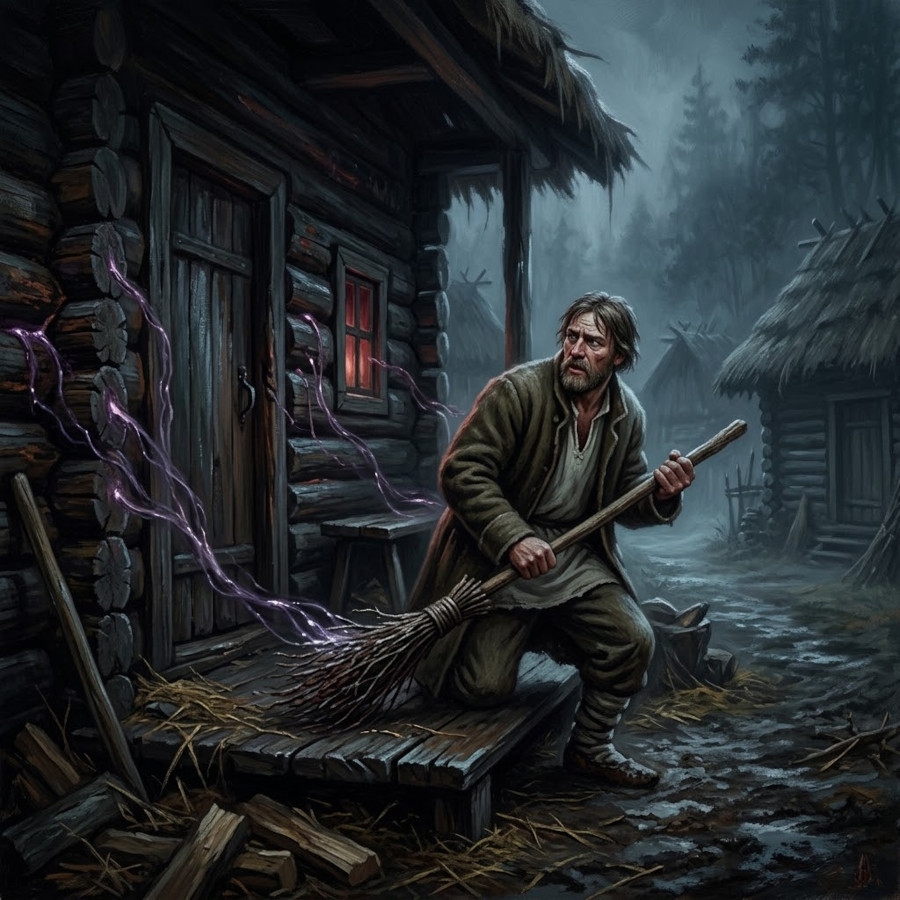
In the realm of archaic myth, a person can become a vital nexus of a ritual without ever suspecting it. Here, they occupy the role of a medium: an individual whose latent magical potency is harnessed by others through misappropriated belongings. In the Bulgarian rainmaking rite, for instance, villagers would covertly steal a broom from a pregnant woman’s courtyard to fashion the ritual effigy of “German.” The woman herself was physically absent, yet the formidable fertility locked within her body was forcibly channeled into the sorcerous working through the stolen object.

🧶 The Magic of Another’s Fate

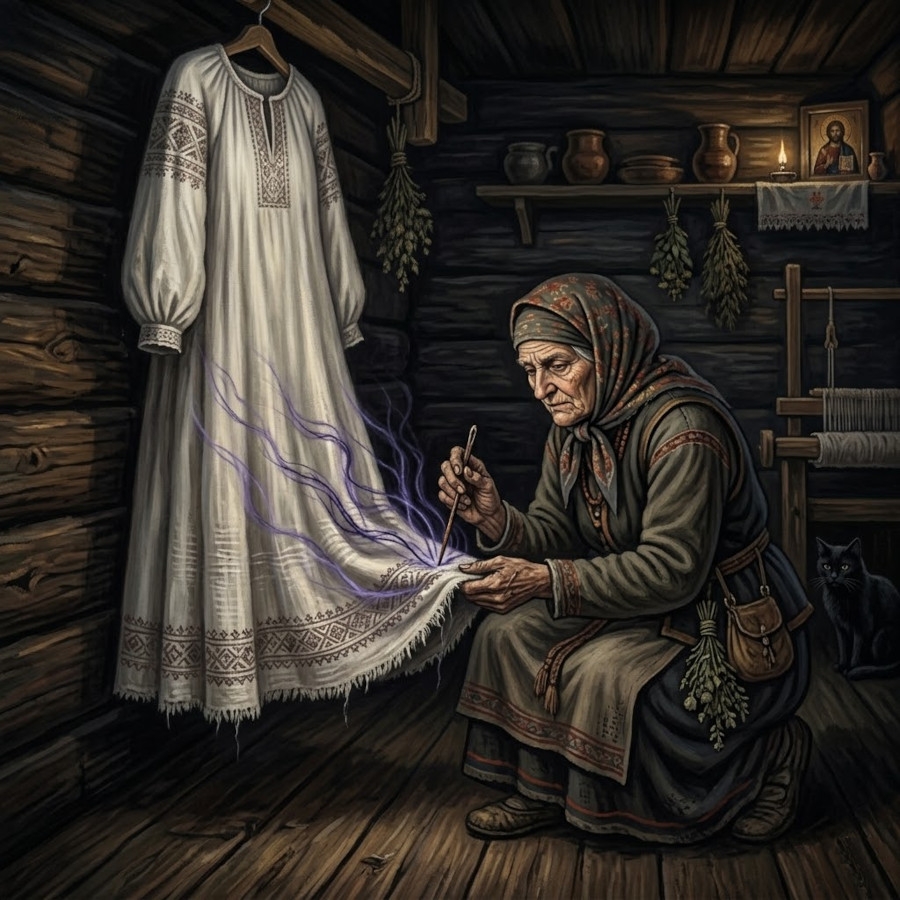
Millennia of folk wisdom show that a distinct social status—or even a name—can turn a human being into a living artifact. To protect a newborn, Serbs in Kosovo stitched swaddling clothes exclusively from yarn gathered from nine widows; in other regions, they wove a sash from the wool of nine women named Stoja. An infant might also be wrapped in the father’s shirt to pass down paternal virtues and forge an invisible armor against misfortune. The destinies, names, and standing of these people served as raw materials, cut and tailored into a new *dolya*—a fresh lot in life—for the one entering the world.

🏺 Cast into the Abyss

Ritual logic leaves no doubt: objects belonging to people of liminal status hold the power to breach a natural anomaly. In Polesia, during severe droughts, peasants sought salvation for the land by casting pots stolen from a potter, an outsider, or a neighbor down a well. By seizing an item from someone bound to the firing of clay or to an alien way of life, the community turned them into a blind conduit—one whose channeled energy, bound to the sunken vessel, forced the subterranean waters to rise.

ꏍꏍꏍꏍꏍꏍꏍ

Employing another’s possessions in magic is no mere symbolic gesture; it is the theft of raw, operative potential. A pregnant woman, a potter, or a widow acts as a living battery charged with a specific essence: fertility, an intimacy with the earth, or the profound gravity of loss. In claiming their broom, yarn, or clay pot, the ritual practitioners physically sever a piece of another’s status and integrate it into their own mechanism. The human medium is doubly stripped of agency: they neither perform the act nor serve as its target, yet it is their latent power that turns the gears of the entire rite.

👇 Have you ever felt a strange, inexplicable emptiness after a personal belonging—a piece of clothing, a tool, or jewelry—fell into another’s hands without your consent, as if a fraction of your unseen vital reserve had been siphoned away with it?

For further reading on the subject: S. M. Tolstaya, *The Human in Ritual: Subject, Object, Addressee, Medium*.

#folklore #ethnography #slavictraditions #magic #rituals

“A Secret Needle in the Hem…” At the Other End of the Thread (Part 3 of 4)

“A Secret Needle in the Hem…” At the Other End of the Thread (Part 3 of 4)

🏹 “A Secret Needle in the Hem…” At the Other End of the Thread (Part 3 of 4)

👕 Power Through the Object

In the traditional peasant worldview, a person’s physical presence at a ritual is by no means required to receive either a magical strike or a blessing. The ceremonial recipient is often someone lying in a fever many versts away from where the sorcery is performed. Village healers (*znakhari*) would carry the undershirt of a sick child to a distant field boundary, reciting incantations as they dragged the cloth through a narrow trench dug into the damp earth. In this rite, the child serves as the hidden recipient of power, while the fabric acts as a beacon, guiding the restorative force unerringly through space to reach its mark.

🛡 A Shield of Good Tidings

The arsenal of Slavic folk sorcery makes frequent use of rituals where certain people act as conduits of power for the protection of others. The benevolent songs of the *kolyadniki* going from yard to yard in winter, or the customary gifts bestowed upon a bride and groom, carry a potent generative charge. In this dynamic, the heads of the household or the newlyweds are passive recipients: they absorb the dense vitality of the spoken word, intended to cast an invisible aegis around them and safeguard the future fertility of their lineage—even without taking any action of their own.

🌑 Remote Hexing

According to the ancient mechanics of the Subtle Realm, a person can become the target of malevolent intent just as easily. To inflict a curse (*porcha*), a sorcerer need only toss charmed food into an unsuspecting neighbor’s yard, surreptitiously pin a rusted needle into the hem of a bride’s dress to render her barren, or twist a knot of grain ears (*zalom*) into a victim’s crops. In such cases, the target remains entirely unaware of the mechanism set in motion—until the chthonic strike, delivered from afar, begins to unravel their health and fate.

To be continued…

ꏍꏍꏍꏍꏍꏍꏍ

A hex or remote healing is not a matter of psychological suggestion, but a precise mechanism for transferring a charge across distance. A needle in a bride’s hem or broken stalks in a grain field function like physical anchors, siphoning the vital resources of the intended victim automatically. The person at the other end of this magical thread is left vulnerable not because of superstitious fear, but because the framework of the unseen world allows remote access to one’s destiny through personal belongings and sacred boundaries.

👇 Have you ever felt a sudden, inexplicable drain on your strength or suffered an unrelenting string of misfortunes, leaving you with the unsettling thought that somewhere, on the other end of an invisible thread, someone might be deliberately meddling with your fate?

#folklore #ethnography #slavictraditions #curse #magic

“The Corpse May Be Considered the Archetypal Object…” The Body as a Target (Part 2 of 4)

🎯 “The corpse may be considered the archetypal object…” The Body as a Target (Part 2 of 4)

🪓 Stripped of Agency

Through the lens of archaic myth, standing at the center of a ritual rarely equates to holding power over it. More often, the living human acts purely as a passive object—a mass of matter subjected to precise technical operations. A bride at a traditional wedding, the gravely ill, or a child undergoing the *postrizhiny* (ritual first hair-cutting) are entirely divested of their own will while others mechanically lead them by the arms, unbraid their hair, smudge them with dense smoke, or ritually shave their heads.

🌲 Through the Spatial Filters

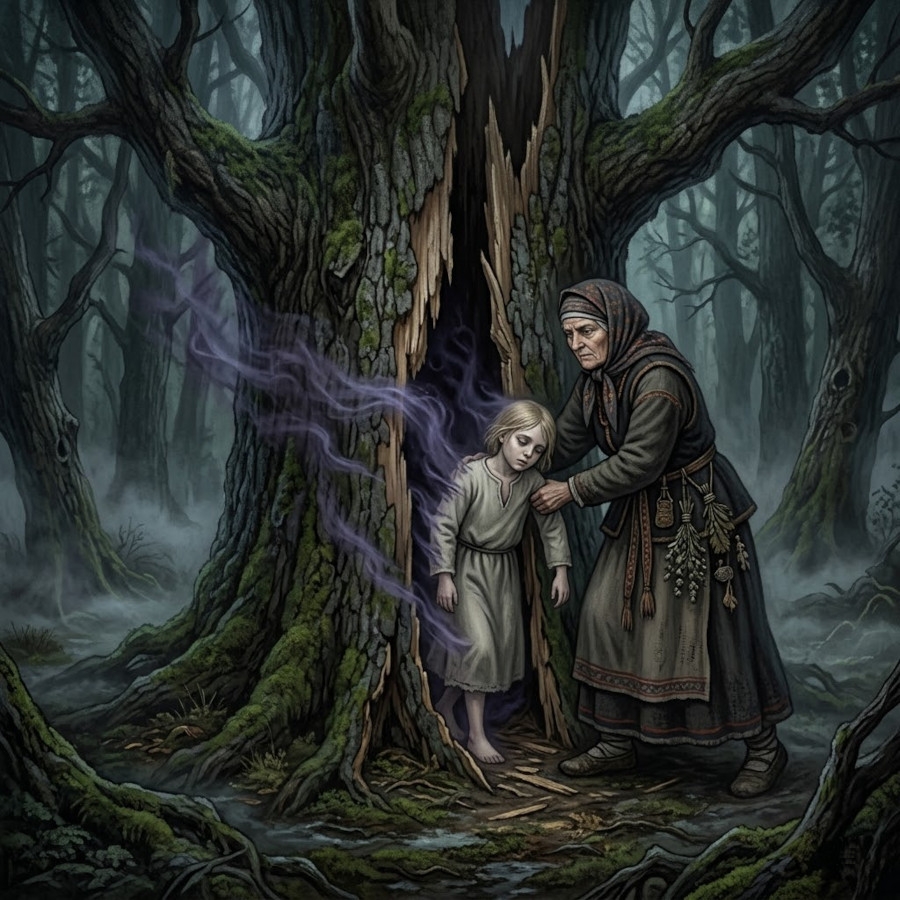
Folk tradition perceives a sickness-afflicted body as a damaged structure that must be forcefully dragged through a physical filter. To cast out an ailment, an infant is forcibly squeezed through the cleft trunk of a living tree or a narrow gap in a fence. To ensure safe delivery, a woman in labor is made to crawl through a wooden hoop or beneath a horse’s harness bow (*duga*). In these preventative and curative acts, the person performs no autonomous deed; they serve merely as a target for the purifying mechanics of the world’s geometry.

⚰ Absolute Inertia

The unyielding logic of archaic folkways reveals the state in which man becomes the quintessential, consummate object of ritual: the corpse. The dead body is entirely subject to the living operators: it is methodically washed with water, dressed in grave clothes, laid into a narrow coffin, and borne to the resting place. Yet within the stern mechanics of the send-off, the deceased’s sheer passivity transforms into a potent instrument: stripped of will, the body itself becomes a medium through which the living dictate their terms to the higher powers.

To be continued…

ꏍꏍꏍꏍꏍꏍꏍ

Assuming the role of a ritual object is not a passive acceptance of human care, but a strict protocol requiring the temporary surrender of subjectivity. At the threshold of structural failure or dangerous transition (sickness, childbirth, death), living flesh is systematically demoted to the status of raw clay, timber, or canvas. To repair the damaged foundation or safely usher it into a new state, the community must drag this inert vessel through the rigid physical filters of the Subtle World, where any personal agency, resistance, or terror would only sabotage the reconfiguration process.

👇 Have you ever caught yourself feeling, in moments of heavy illness or sheer exhaustion, as though your body no longer belongs to you—instinctively wishing that someone else would take the reins and simply, mechanically “fix” you?

#folklore #ethnography #slavictraditions #ritesofpassage #funeralrites

«…”Involuntary” Participants…» Operators by Compulsion (Part 1 of 4)

«...

⛓ «…”Involuntary” Participants…» Operators by Compulsion (Part 1 of 4)

🩸 The Burden of Status

In the mythological worldview, the enactment of a ritual is not a social performance, but grueling magical labor that demands the precise calibration of the practitioner. Often, an individual becomes the principal agent (subject) of a rite not of their own volition, but because their social or kinship status binds them inextricably to the role. The parents of the betrothed, a pregnant woman, or a widow are woven into the fabric of the ritual by the sheer fact of their existence: their sacred rights and duties are dictated by tradition, leaving no room for personal choice.

👁 Blind Fate

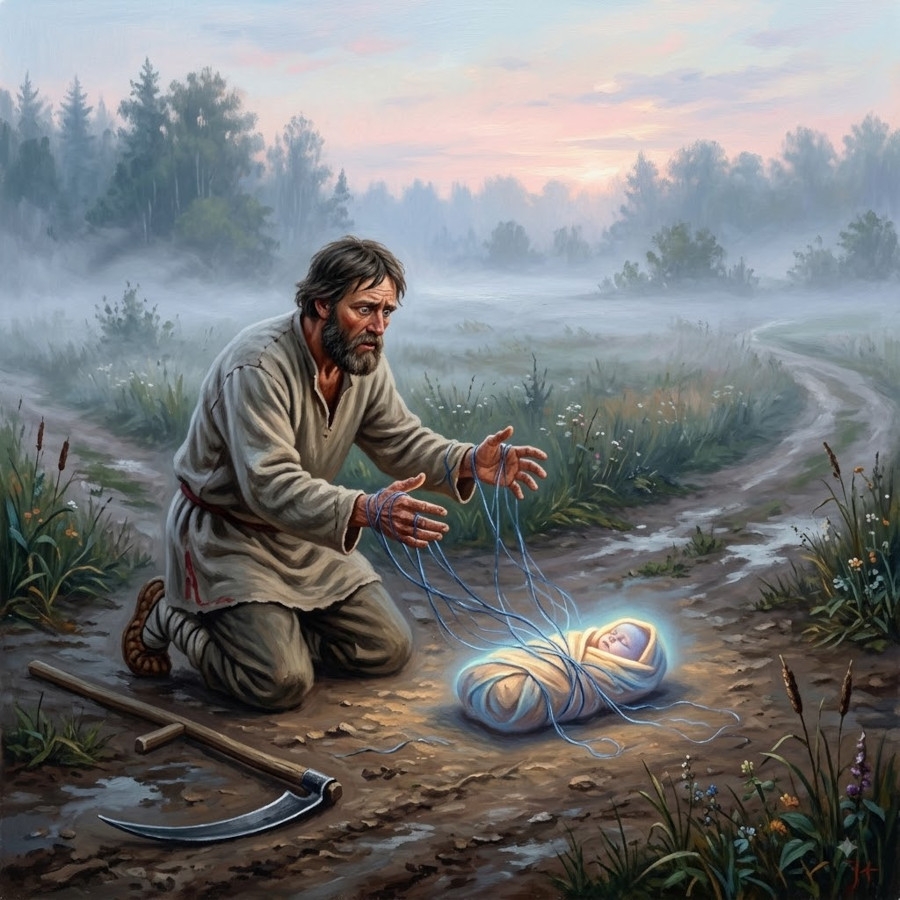
Ancient order inexorably dictates that at the breaking point of destiny, a completely random wayfarer can become the agent of a rite. The first stranger encountered on the road or the first visitor to cross the threshold (the *polaznik*) on a designated day is organically swept into the ritual, becoming its key operator. Such a person unwittingly acquires dominion over another’s fate: for instance, by chancing upon an abandoned infant, they automatically become its ritual sponsor—a *kum*—shouldering spiritual responsibility for its life to come.

🤐 Unseen Vigil

Among ritual operators, there exists a peculiar caste: the so-called outsiders, or onlookers. Ritual tradition defines them as participants whose primary act is the sheer state of observation, witnessing, and keeping watch over the unfolding magic. At weddings, they bar the path of the bridal cortege (*poezd*), demanding a ransom, and hail the newlyweds, forging a dense ring of concentrated gaze around the central mystery—without which the rite cannot anchor itself in reality.

To be continued…

ꏍꏍꏍꏍꏍꏍꏍ

Participation in a rite is not an act of homage to ancestors, but the strict execution of operational protocols within the machinery of the cosmos. Social status or a chance encounter serves as an inescapable clearance code to flip the switchboard of reality. Man does not choose magic; the architecture of the Unseen Realm seizes an appropriate physical node (a widow, a *kum*, a passerby) and conduits through it the current required to sustain cosmic order.

👇 Have you ever wondered why the “first stranger” (encountered on the street, in the morning before an important undertaking, or on New Year’s Day) is still unconsciously perceived as a harbinger of fate, capable of programming the entire day ahead through a single offhand phrase or their mere presence?

#folklore #ethnography #slavictraditions #ritesofpassage