THE VAMPIRE IN SLAVIC TRADITION | Part 1/2
Hail to you, good folk! 👋
Today, let’s forget about pale-skinned Hollywood heartthrobs and talk about the monsters our ancestors truly feared. Brace yourselves—it’s going to be chilling, but endlessly fascinating!
🧛♂ Shadows of the Ancestors: Who is the Real Slavic Vampire?
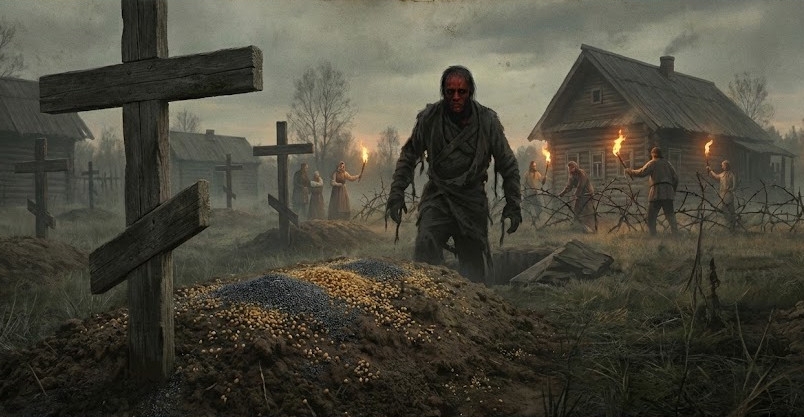
Forget everything you’ve seen on the silver screen. A true Slavic vampire is no brooding aristocrat cloaked in velvet. This creature is far more ancient, primordial, and terrifying. In common Slavic folklore, a vampire (or *upyr*) is a corpse that rises from its grave by night. Its purpose is brutal and direct: it torments the living, ruins households, slaughters livestock, and, above all, gorges on blood.
Belief in these revenants reaches back into the mists of antiquity, rooted in the dread of those who refuse to remain truly dead.
🗺 A Geography of Fear and Names
Curiously, the further northeast you journey into the Slavic lands, the fainter these beliefs become. In the Balkans, however, vampire lore was an all-consuming reality. In fact, the very word we use today—“vampire”—traces its roots directly to Bulgaria and Serbia (where it was also known as a *grobnik*, a grave-dweller).
Yet nearly every land had its own name for this nocturnal stalker:
🇺🇦 Ukrainians spoke of the *upyr* (упир).
🇧🇾 Belarusians whispered of the *upor* (упор).
🇨🇿 Czechs feared the *upír*.
🇵🇱 Poles use the word *wampir*, but preserve a unique title for a female vampire: *opica*.
🇷🇺 Russians harbored a closely related archetype: the *zalozhny pokoynik*—the restless, “unclean” dead.
Make no mistake, this is no modern invention. Mentions of vampires appear in Old East Slavic manuscripts as early as the 14th century! These ancient records even recount *treby*—pagan sacrificial offerings—made directly to the *oupiri*.
👥 The High-Risk Circle: Who Becomes an Upyr?
Our ancestors were certain of one thing: nobody becomes a vampire by chance. It was the cursed fate of those whose life, death, or very birth crossed the sacred boundaries of tradition.
Here is the roster of prime “candidates”:
⯈ Suicides and murderers.
⯈ Those who perished from festering wounds or pestilence.
⯈ Sorcerers, misers, and chronic drunkards.
⯈ Anyone who suffered an unnatural, violent, or untimely death.
The liminal hours between physical death and burial were deemed extraordinarily hazardous. South Slavs believed a corpse could instantly turn into a vampire if the living made a single misstep:
🔸 If an object was passed or dropped across the body.
🔸 If raindrops touched the uncovered corpse.
🔸 If an animal leaped over or a bird flew across the deceased.
👶 Born into the Dark
At times, destiny was sealed at birth. In the Carpathian Mountains, folk cast wary eyes on a fifth or seventh son born without an unbroken succession of sisters, as well as anyone suspected of possessing two hearts or two souls—the dreaded *dvoedushniki*.
South Slavic traditions held their own grim omens: a child was doomed to turn if their mother, while carrying them, ate meat from an animal torn by a wolf—or if the child was sired by a vampire itself.
Crucially, it was believed that vampires were predominantly male. Women turned far less frequently. According to Macedonian lore, such a fate awaited only those who had lived as enchantresses, cunning women (*znakharki*), or who had died in the agony of childbirth.
🌘 Living Vampires and the Two-Souled
Most terrifying of all: a vampire was not always a rotting corpse. In Ukraine, Poland, and eastern Serbia, folk lived alongside *living vampires*. These were sorcerers and *dvoedushniki* (the two-souled). While their mortal shell lay asleep, their second soul could slip out into the night to bring ruin upon their neighbors. In the Kharkiv region, legends claimed a living vampire could hide his soul beneath a stone—and so long as it lay untouched, he could never truly die!
How could you unmask a living vampire?
❄ Cold to the touch: Macedonians believed their bodies turned ice-cold after nightfall.
🌑 Casts no shadow: South Slavs held that a living vampire walked without a shadow.
😡 A flushed face: Their complexion was perpetually ruddy and engorged with stolen blood. A Kashubian proverb warns: *“Cervoni jak v́ešči”* (“Red as a vampire”). This flush clung to them even in death.
🐑 The butcher’s trade: If a living vampire worked as a butcher, the livestock he slaughtered miraculously bled not a single drop.
In Western Ukraine, village folk knew a cunning trick to incapacitate a sleeping *upyr*: they would flip his body around so his feet rested where his head had been. It was believed that the wandering soul, upon returning, would fail to recognize the body’s orientation, lose its way, and leave the monster trapped in eternal sleep.
ꏍꏍꏍꏍꏍꏍꏍ
👇 As lore tells us, a living vampire could be unmasked by an absent shadow or an unnervingly blood-red face. Have you ever crossed paths with someone whose aura, looks, or habits were so unsettling that our ancestors would have branded them a *dvoedushnik* without a second thought?
For deeper research, consult: *Slavic Antiquities: An Ethnolinguistic Dictionary*, edited by N. I. Tolstoy.
#slavicmythology #folklore #slavicfolklore