
🔥 The Wedding Path: Magic in Motion and the Pea Hex (Part 3)
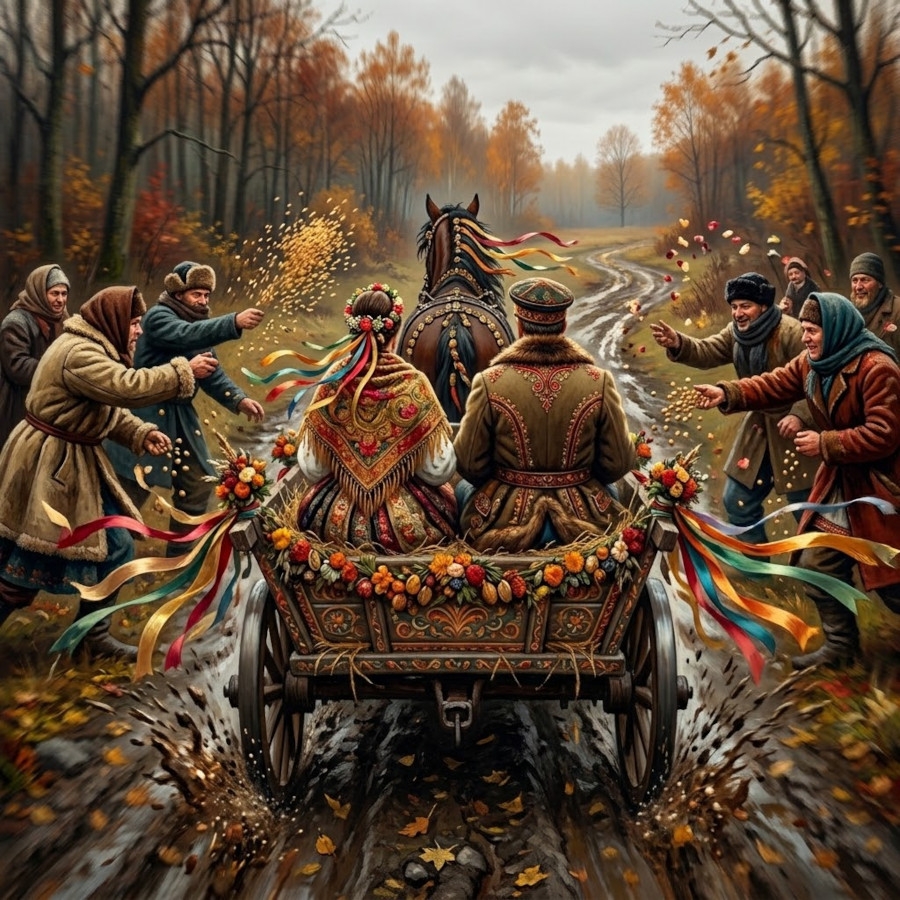
Traversing alien territory demanded more than just ritual offerings; it required magical camouflage. The traditional wedding train (*poezd*) was, in essence, a raiding party cutting its way through hostile lands under the shield of rigid behavioral taboos and protective speed.
🤐 Resolute Silence
To avoid drawing the attention of unseen threats and ward off the evil eye, the bride and groom often retreated into ritual muteness. In the Russian North and among Bulgarians, the newlyweds maintained unbroken silence on their journey to the church. Among the Slovaks of the Upper Hron region, the entire trek unfolded without a single song, draped in a heavy, anxious quiet. A Serbian bride went further still: she not only kept silent, but kept her face completely veiled, forbidden to dismount or even let her feet touch the earth—suspended in total isolation, like a creature walking between worlds.
🐎 Breakneck Gallop
When concealment failed, speed became the only shield. A wedding cortege from Vologda rode with reckless bravado (*molodchestvo*): charging at full tilt, daringly holding course, never yielding the road to anyone. In the Polesia region of Belarus and among the Lusatian Sorbs, processions raced toward the church at blistering speeds, while in Vyatka Governorate, drivers rode with one leg defiantly swung over the side of the wagon. In Montenegro, the mounted escorts might ignore roads altogether, cutting a straight line to the groom’s homestead right across private fields. Speed was a weapon to outrun time and slip through sorcery, giving dark forces no handhold on the passing train.
🕷 Nine Peas and Bear Grease
Well aware of how vulnerable a moving escort was, black sorcerers (or rival cunning folk hired by ill-wishers) struck mid-stride, aiming to freeze the horses dead in their tracks. Among Russians and Belarusians, the most dread weapon was an ordinary pea pod: in Vologda Governorate, a sorcerer would cast a pod containing nine peas onto the road while whispering an incantation, causing the horses to halt petrified or miraculously slip their harnesses. In Vitebsk Governorate, a team would refuse to move if a bound flea was placed on the road before them, while in Pskov, the flea was sealed inside a hollow straw. In northern Belozerye, a matchbox holding a cockroach was thrown in their path—which the horses, through witchcraft, perceived as a towering bear. Along the Kama River, aspen stakes smeared with bear grease were driven into the roadside. Once brought to a standstill by such magic, the horses could only be reharnessed by bare hands holding a wisp of hay; failing to do so doomed the couple to a bitter life together.
ꏍꏍꏍꏍꏍꏍꏍ
The bridal journey truly ended only when the procession broke into its own domesticated space—the familiar locus. In Ukraine, the newlyweds were driven through a purifying fire of burning straw lit right in the gates of the groom’s courtyard. The wild gallop, ritual muteness, and simulated deaf-and-blindness were ancient methods of shielding oneself from an untamed world—a desperate bid to slip unseen through the liminal boundary where mortals stood utterly defenseless before curses, hexes, and foreign malice.
🔥 Today, our motorcades no longer thunder blindly down dirt roads or dodge dung carts. Yet the tradition of tying cans to bumpers, blaring car horns, and speeding down the avenue survives. What do you think: beyond pure revelry, what elements of modern wedding processions still subconsciously echo that ancient impulse to “scatter unclean spirits” and fiercely guard the perimeter?
For further reading on this subject: A. V. Gura, *The Ritual Path in the Slavic Wedding Rite*
#folklore #ethnography #slavicmythology #weddingrites #incantations