

🐻 Chronobiology of the Wedding: Forty Days of Impurity and the Bearskin (Part 3)
In traditional wedding ritualism, the bride acts as the Ground Zero of a chronological anomaly. Crossing the threshold of the groom’s home, she breaches a spatial boundary, only to hang suspended for forty long days in the void of untraversed time. During this liminal period, she carries a terrifying dual nature: as a conduit of fertility she is profoundly potent (in western Bulgaria, she is even disguised as a she-bear and made to dance a ritual dance), yet as an outsider arriving from the unknown, she poses a lethal danger to the living.
🌑 Fear of Sunset and Mirrors
Her isolation begins at the betrothal. The maiden is strictly forbidden from looking into a mirror until the wedding night. She is completely stripped of the right to interact with the outside world after dark: she cannot step outside past dusk (*слънцето да не я залязва навън* — “lest the sun set upon her out of doors”).
🚫 The White Wool Quarantine
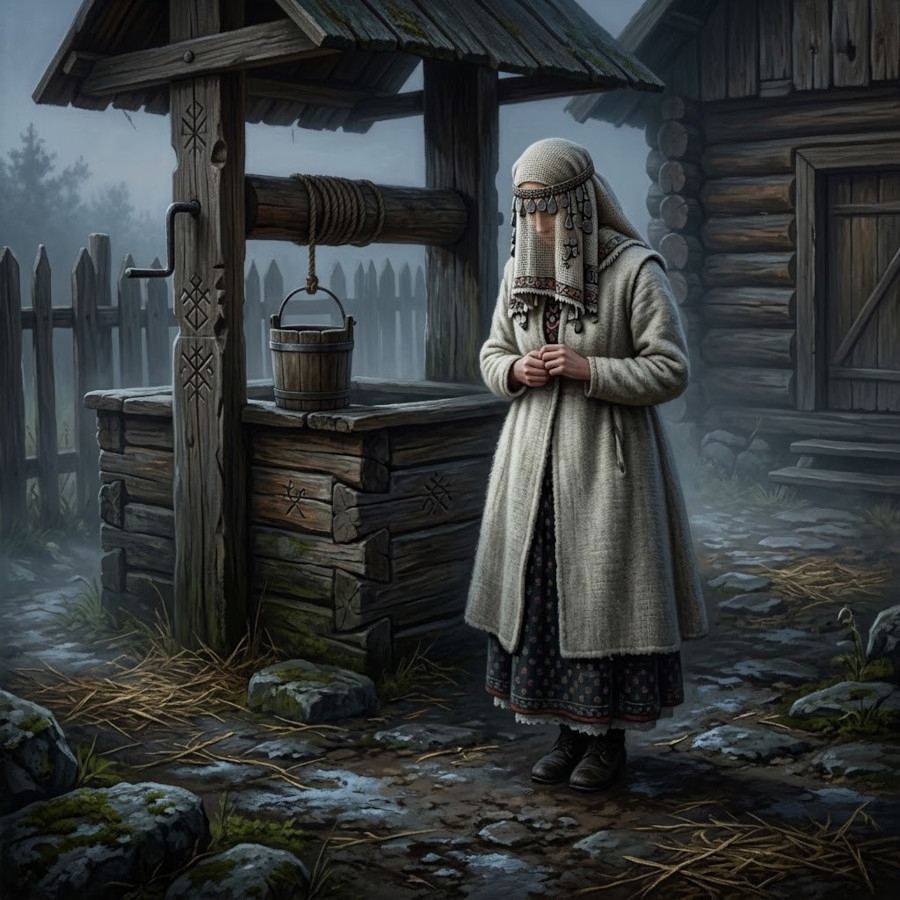
Following the church crowning, a forty-day—and at times year-long—quarantine begins. The *molodukha* (newly wedded woman) is deemed ritually “unclean.” Her bridal veil remains untouched for as long as possible, shielding this vulnerable soul from being struck down by *lekhusi* demons. A heavy shroud of taboos falls over her: she is forbidden from walking barefoot, bareheaded, or without outerwear—near Edirne (Odrin), she wears a long, sleeveless white wool coat (*byala gunka*) for an entire year. She must not draw near the well, lest its waters become infested with worms, and she is categorically barred from attending funerals.
🗝 Emerging from the Void
The lifting of the quarantine and the exit from this temporal void follow an unbending schedule. On the fortieth day, a prayer of purification is recited and ritual breads are distributed. Yet the final removal of all prohibitions—the ceremonial “undressing” (*sablichane*) and “unshoeing” (*sabuvane*)—is observed only at major crossroads of the folk calendar: Saint George’s Day (Yuryev Day), Ascension Day (*Spasovden*), or Winter Saint John’s Day (Ivanovden).
ꏍꏍꏍꏍꏍꏍꏍ
In the traditional worldview, crossing from one social status into another is never an instantaneous flash of celebration, but a slow, agonizing smelting of one state of being into another. During these forty days, the young bride behaves like a radioactive isotope of transition: she is insulated behind dense wool and unyielding taboos so that her threshold state does not poison the vital space of the community—and so the mundane world does not crush her unseen, nascent flesh.
🐻 Today, these ancient quarantines are long forgotten, yet the instinct endures. In which modern wedding or post-wedding customs do you still recognize that primal urge to conceal, shield, or isolate newlyweds from outside eyes?
For further reading: E. S. Uzeneva, *Time in the Bulgarian Wedding*
#folklore #ethnography #slavictraditions #bulgarians #wedding
[Localization Notes]
*Lekhusi* refers to dangerous Balkan demonological spirits (from the Greek *lechona*, woman in childbed) traditionally believed to torment and kill women suspended in liminal reproductive states (postpartum mothers and new brides). The Bulgarian terms (*byala gunka*, *sablichane*, *sabuvane*) have been transliterated according to standard Bulgarian romanization rules with functional ethnographic glosses.