

🕰 Chronicles of Living Time: The Calendar in the Mind and the Humbling of the Wise (Part 1)
In the traditional Slavic worldview, time is no abstract grid of numerals printed on paper, but a dense, tangible substance suffusing the natural world. To the peasant, an official, city-printed calendar is a lifeless contrivance, severed from the breathing earth.
🧠 The Internal Chronometer
The Hutsuls, bound inextricably to the natural rhythms of the Carpathians, rely solely on an inner compass. They prefer to consult “their own household calendar kept in the head” (*svoyim domashnym kalendarem yz holovy*). The ancestral folk order is unyielding: survival lore forged across centuries never fails to signal the arrival of sacred feast days (*s’yetky*) or an impending shift in the weather. City-made calendars, by contrast, are dismissed as deceitful scraps of paper unworthy of trust.
📜 The Collapse of Bookish Learning
This stark clash of worldviews is captured vividly in a Carpathian folktale about urban scholars—the *mudrahelyky*, or self-styled wiseacres. A physician (*dokhtor*), a clockmaker (*hodynnykar*), and an astrologer (*zvizdar*), who place their blind faith in books and clockwork, suffer a crushing defeat when caught in a village downpour. They fail to foresee the storm, lose all sense of time without dials, and have no notion of how to heal an ailment without apothecary drafts.
🐂 The Living Physics of Everyday Life
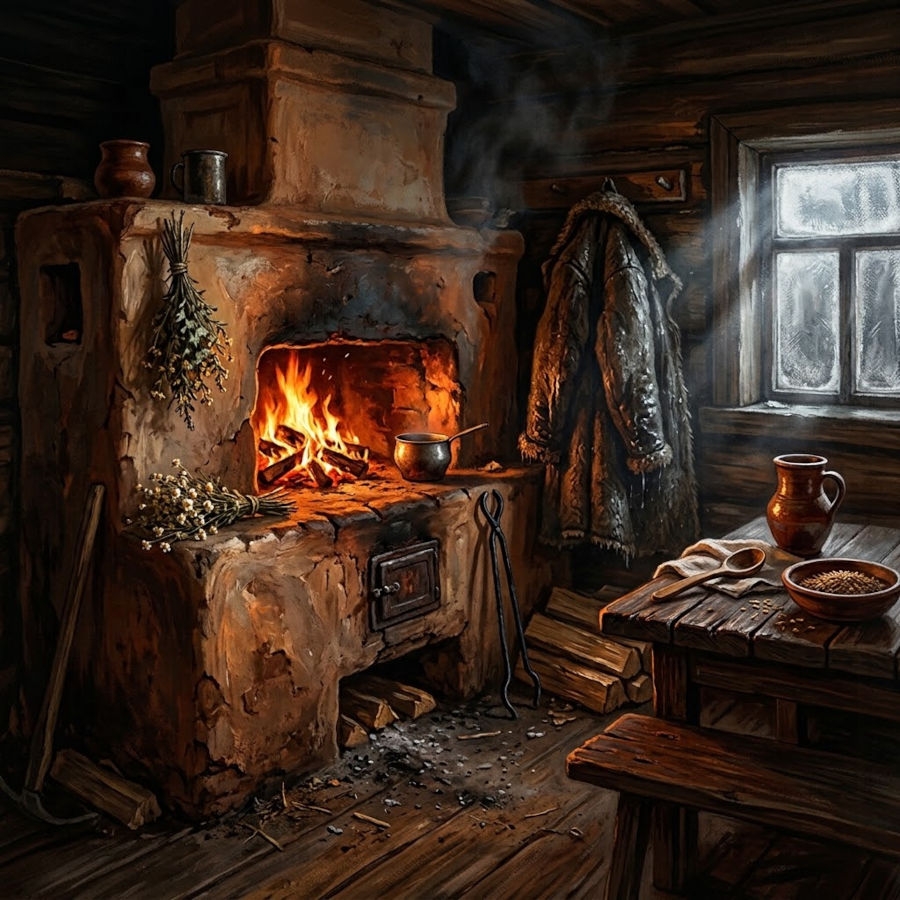
The peasant’s answer to these humbled sages reveals an authentic, fail-safe technology of living. Paper learning proves utterly powerless where time and weather can be read directly from the fleece of livestock and the turn of the wind. For the villager, a scorching clay stove is the sovereign healer, his own peasant constitution (*khlopska natura*) serves as an immaculate timepiece, and his livestock (*marzhyna*) functions as an absolute, unerring calendar of nature.
To be continued…
ꏍꏍꏍꏍꏍꏍꏍ
Abstract time, locked within typographic tables, has no flesh. Tradition teaches that the true chronometer pulses in the blood, creaks in the floorboards, and breathes in the barn. Surrendering entirely to the printed word and mechanical contrivances breeds blindness; yet one who is woven into the living fabric of nature reads time like an open book, needing none of civilization’s fragile crutches.
🕰 Urban life has long severed us from the ability to feel time without clock dials and phone forecasts. Can you recall a time when your elders (or you yourself) unerringly predicted a change in the weather, the exact hour of the day, or the season’s harvest purely by instinct, the behavior of animals, or subtle natural signs? How was that uncanny insight explained in your family?
#folklore #ethnography #slavictraditions #hutsuls #folkcalendar
[Translation Notes]
Carpathian dialect terms (*mudrahelyky*, *s’yetky*, *marzhyna*) were preserved in transliteration alongside precise contextual equivalents to maintain authentic ethnographic color without stalling narrative flow for fantasy or graphic-novel readership.