

WEATHER MAGIC AMONG THE SERBS: Part 1/3
🌩 Iron, Shouts, and Bread-and-Salt: The First Line of Defense
When a black storm cloud gathered over a Serbian village, the peasant knew: the “white cattle” (the celestial herd) were coming, driven across the sky by demons or the unquiet dead. In Dragačevo, hailstorms were met fully armed.
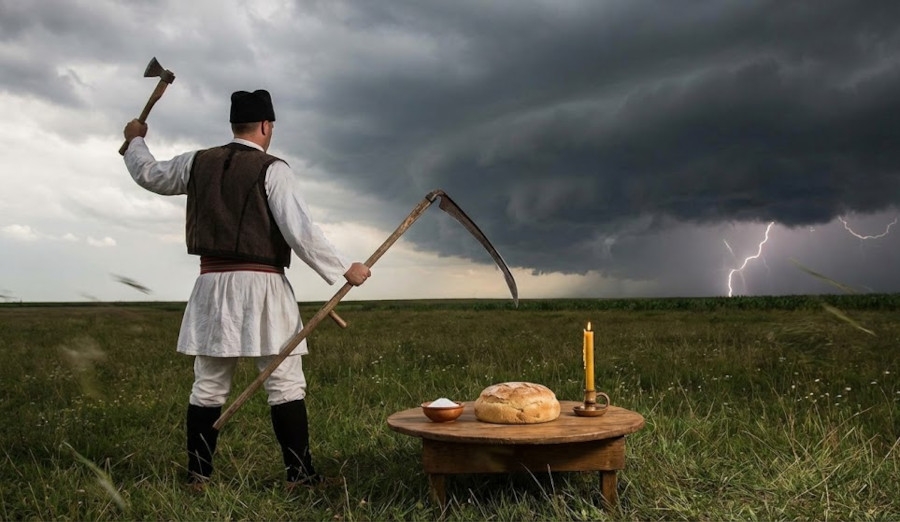
⚔ The Cleaving: Battling the Sky
The peasant’s primary weapon against hail was sharp iron. Axes, scythes, sickles, and hoes were all brought into the fight. In the village of Goračići, mowers caught in the open fields would remount their scythe blades backwards and slash them at the storm cloud, believing this could “cleave” the hail apart. Axes were hurled directly into the sky or struck deep into the earth, edge pointing upward, to “cut the hail in two.” In Guberevci, men brandished their scythes and chanted: “Hey, storm cloud, do not strike the mowers!”
Wooden weapons were used as well. There was a specific staff known as the *ustukač* (from *ustuk*—”retreat”). This goad, normally used to drive oxen, was shaken at the sky with a fierce cry: “Turn back, little bull, keep your white cattle penned!”
🦷 Teeth and Nakedness
If hail broke through anyway and began to batter the fields, the peasants turned to the magic of the body. One had to snatch up the very first hailstone and swallow it whole, or bite it cleanly in two. In Takovo, folk believed this act alone would make the hail cease at once. This task was often entrusted to children: either the *neporođeno dete* (the family’s youngest child) or the firstborn.
To terrorize the cloud itself, the women of Dragačevo would run circles around the house naked, or with their skirts hoisted high. In the village of Rogača, women stripped bare, dashed around the homestead, and screamed toward the heavens: *”Okolo, bogo! Bokom, божок!”* (“Turn aside, god! Pass by our flank, little god!”). Ritual nakedness was believed to terrify and repel the supernatural storm.
They also fought the sky with deafening noise: firing rifles and *prangije* (small mortars), striking empty watermills, and deliberately provoking bulls to roar and swine to squeal.
🍞 The Offering: A Feast for the Demon
When violence failed, the villagers sought appeasement. This was the ritual of “hospitality.” A low dining table—a *sofra*—was carried out into the yard, set with bread and salt, accompanied by spoons and forks.
The centerpiece of this offering was the *Slavska sveća*—the sacred candle blessed during *Slava*, the feast of the family’s patron saint. Preserved carefully throughout the year, it was lit before the gathering darkness as an appeal to the ancestral holiness of the clan. Sometimes an Easter egg and ritual Christmas bread were placed upon the table as well. In Goračići, the peasants shouted into the gloom: “Bread and salt for us, but the table is bare for you, Stanko the Drowned!”, casting out the uninvited guest.
ꏍꏍꏍꏍꏍꏍꏍ
👇 Here we witness two stark extremes: either assaulting the elements with cold steel and wrath, or laying a feast and meeting the tempest with bread and salt. Which approach do you think was psychologically more effective for people of old facing terror: venting their aggression (slashing the sky with scythes), or performing an act of humility and communion (bringing out the bread)?
For further reading on the subject, see: N. I. Tolstoy, *Essays on Slavic Paganism* (*Ocherki slavyanskogo yazychestva*).
#slavicmythology #folklore