
🪓 Bloodline Engineering: Keeper of the Frontier (Part 1)
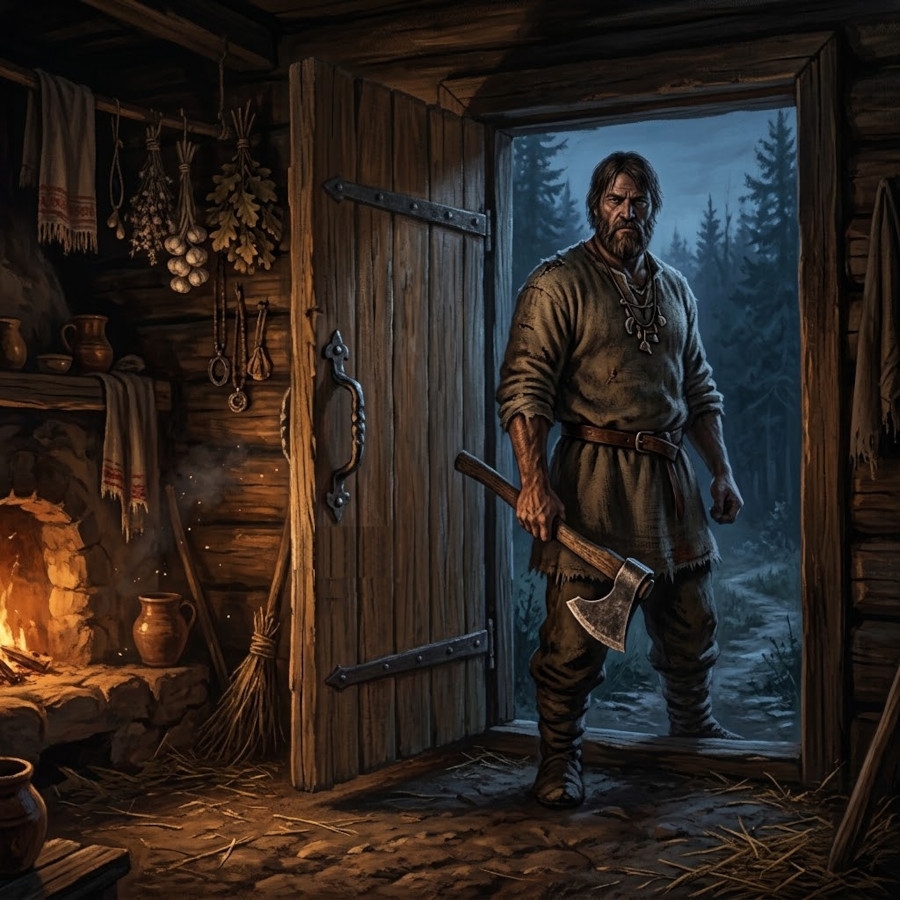
In Slavic funeral laments, the family is no sentimental circle of kin, but a rigid, functional survival machine. Here, each member of the clan is judged not by abstract warmth of soul, but by the specific breach they seal in the homestead’s defenses. And the male figure—husband and father—stands as the absolute organizing core of this system: the keeper of its outer frontier.
💪 The Master-Steward
When a widow mourns her husband, she mourns the collapse of a load-bearing pillar. In East Slavic laments, a good husband is, above all, a tireless plowman and an overseer. Death is recorded through a formula of catastrophic void: in the Russian North, mourners wail that now “there is no plowman in the open field, no woodcutter in the dark forest.” In Belarusian laments, the orphaned yard asks who will now “plow the field” (*niwku arats*), “scythe the hay” (*sena kasits*), and “watch over the threshing barn” (*humno pahlyadzits*). Meanwhile, a Ukrainian widow evokes her departed husband concisely through labor: *“Oy, my little scythesman, my little plowman!”* (*“Oy myy kosaryku, myy ratayiku!”*), *“My provider, my procurer!”* (*“Moy dostavalnychku!”*).
🛡 A Bulwark Against Driving Rain
The chief virtue—both magical and physical—of the householder is his ability to establish order and shield his own. In Northern Russian lamentations, the father-protector is likened to a fortress, hailed as the “city wall” (*stena gorodovaya*) and “our dear defense” (*nasha oboronushka*). A widow weeps that she has lost her “shelter from the pouring rain” (*ot chasta dozhdya zatulushki*). This same piercing metaphor echoes in Ukrainian laments from the Poltava region: *“My husband, my shield! I hide behind you and fear no one”* (*“Miy cholovyche, miy zatulo! Ya za tebe zatulyusya tay nikoho ne boyusya”*, from the verb *zatulyty*—to shield, to cover). The man is the physical bulwark behind which the kinfolk take refuge.
⚖ Our Counsel and Command
Beyond physical defense, the master of the house upholds the *uryad*—the ordained order of things. In Ukrainian and Belarusian texts, the core concepts are *rada* (counsel) and *poryadok* (order and governance). The deceased is addressed as “our counsel and guidance” (*“nasha rada y porada”*) or “my dear steward of order” (*“paradnichak ty moy mily”*). The need for this firm male rule was so profound that even over an infirm husband unable to do heavy labor, a widow would lament: *“And you, though you did no toil, gave counsel… you commanded me, and I worked, and all was well…”* A man might not plow the soil himself, but he was duty-bound to *command*, keeping the world from unraveling into chaos.
To be continued…
ꏍꏍꏍꏍꏍꏍꏍ
In mourning a husband and father, the Slavic woman mourns the loss of the will that kept chaos at bay. In this archaic engineering, love was not expressed through idle sighs on a bench, but through shared, finely tuned, relentless labor. To lose the *bolshak*—the master of the hearth—meant facing a hostile world alone, stripped of shield and compass alike.
🗝 Recall a time when a person in your family or circle—even without performing grueling physical labor—held the entire fabric of life together through sheer presence and commanding spirit. What do you think underpins this invisible authority in modern families?
#ethnography #slavic_traditions #folklore #family #funeral_laments