
🌑 The Four Guardians of the Izba: The Feminine Pole (Part 2)
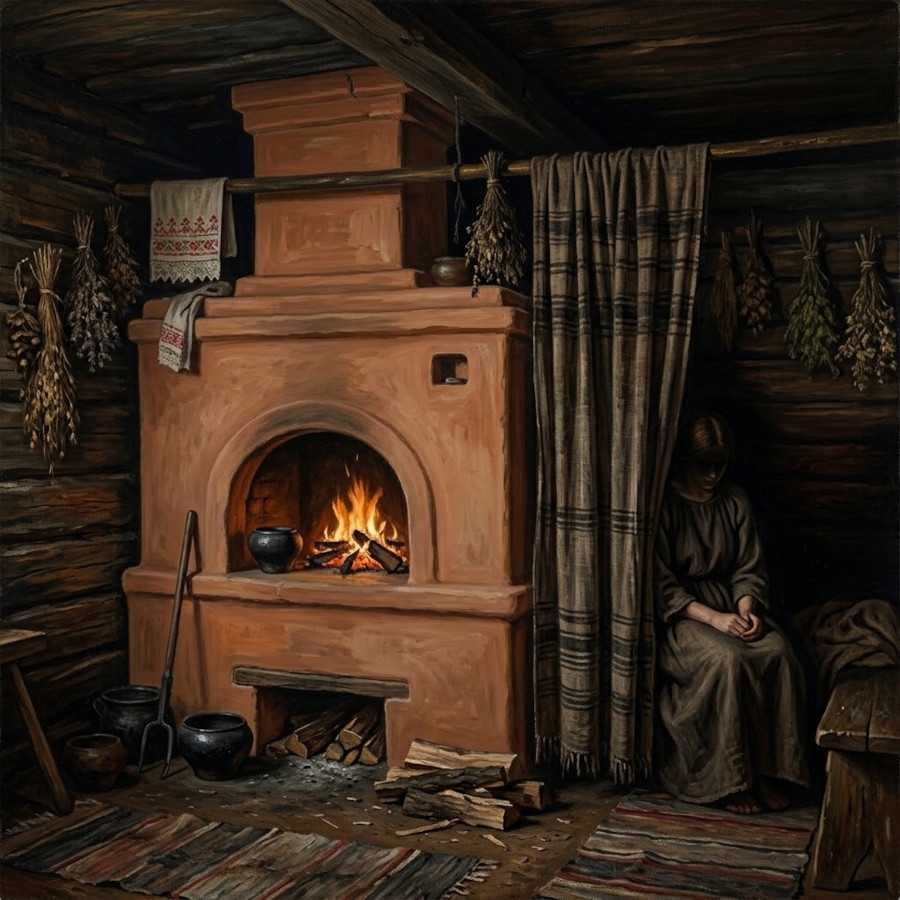
The diagonal axis of a traditional Slavic home is charged with a sharp tension between two opposing poles. While the “Red” (or beautiful) corner is bathed in light, embodying patriarchal order and the law of men, a deep shadow falls diagonally across from it beside the hearth—the secluded threshold of female mysteries and life-altering transitions. Known in folk tradition as the stove corner, the women’s corner (*babiy kut*), the hearth-bottom corner (*podoviy*), or sometimes simply the “yellow corner,” it faces west or north. This is an exclusively feminine sanctuary—the *kut* or *sereda*—shielded from foreign eyes behind woven drapes and rough-hewn wooden partitions.
🩸 The Canopy Mother
The stove corner serves as a liminal quarantine zone where human life is at its most fragile. It is here, sequestered behind a bed-curtain, that a woman is hidden during childbirth and throughout the perilous days that follow, when both mother and child are utterly defenseless against curses and the evil eye (*porcha*), yet also spiritually volatile and dangerous to those around them. In the Vitebsk province, a mother in this transitional state was called the *pologovaya kuma* (“canopy godmother”); among Moravians, she was the *koutnica*, and among Slovaks, the *kútnica* (she of the corner). To ward off malevolent forces, this shadowed alcove is sprinkled with holy water, rubbed with garlic, and ringed with salt and poppy seeds. Confining the woman in childbed to the stove corner thus serves a dual purpose: it isolates her from the rest of the household while returning her to her own primal, sovereign element.
💧 The Weeping Corner
For a bride-to-be, the *kut* is the sacred ground where she mourns the death of her maidenhood. In traditional wedding laments, it is invoked as the “somber” or “weeping corner.” Following her betrothal, the bride remains physically confined within this space: stitching her dowry, weeping on the bench, and reciting ritual dirges to bid farewell to her youth and girlhood liberty (*devichya volya*). It is here, in this secluded recess, that her maidenhood is surrendered forever. Only after the ritual exchange of gifts is the bride solemnly led out from behind the hearth screen to join the groom in the radiant Red Corner—a physical crossing that marks the irrevocable shift in her social destiny.
🔥 The Voice of the Hearth
The feminine pole resonates directly with the fates of its mistresses. According to Vitebsk lore, if an ominous cracking sound issues from the *zapechye* (the dark crevice behind the stove), it portends the imminent death of a woman in the household (just as a crack in the Red Corner foretells the demise of a man). Yet this corner also summons prosperity: in the Novgorod region, when crossing the threshold of a new home, the master rolls a loaf of bread across the floorboards. If the *karavai* rolls straight toward the hearth, it promises wealth to the mistress and blessings upon her domestic labor.
To be continued…
ꏍꏍꏍꏍꏍꏍꏍ
In the folk metaphysics of the home, the stove corner is far more than a kitchen; it is the sacred crucible of the kin. While life in the Red Corner is consecrated by social authority and the rule of ancestors, in the women’s corner it is physically forged—brought forth through blood, tears, and the agony of passage. It is the hidden, nocturnal underbelly of existence, without which the daylight order of the masculine sphere could never stand.
🗝 For generations, the hearth and the shadows surrounding it remained the beating heart of female mystery and retreat. Modern living spaces have long since discarded the traditional stove, yet the primal need for a safe, secluded sanctuary remains unchanged. Where and how do you carve out this invisible haven for quietude and restoration in your own home today?
#ethnography #slavicmythology #folklore #hearth #womenslore