🌊 The Wedding Journey: The River Threshold and Another’s Destiny (Part 2)
Having broken through the gates of the homestead, the wedding train enters open territory—a realm where space no longer belongs to mankind. Forests, rivers, and crossroads are perilous liminal zones, each demanding a sacrificial tribute or an intricate protective ritual.
💧 Dark Waters and the Halting of Time
A river marks one of the primary thresholds along the path. At this juncture, the bride is duty-bound to leave a ransom. Bosnians offer an article of clothing to the water, while Latgalian Russians cast a woven belt into the current. A Serbian bride washes her face and tosses a coin from the bridge, sealing this sympathetic somatic magic with an incantation: *“Pređoh vodu, ne ugazih, rodih dete, ne osetih”* (“I crossed the water without getting wet; I bore a child without feeling pain”). The Poles of the Chełm Voivodeship dread that a *vodyanoy* (water spirit) might snatch the bride from the surface, or that one of the newlyweds will soon perish. Meanwhile, Belarusians of the Grodno Governorate, when passing a watermill, demand that the flow and the mill wheel be stopped completely—lest the bride’s entire life spin endlessly like a wheel in turmoil.
🕸 Dancing at the Crossroads
Crossroads are another dangerous realm along the ritual journey, places where the unclean force gathers in strength. Croats of Central Dalmatia make the sign of the cross at every fork in the road, knowing that it is precisely here that the *veštice* (witches) dance their circle dances. Among the Russians of the Middle Volga, the bride casts an onion onto the crossroads, ritually and permanently abandoning her pre-nuptial tears in this “unclean” place.
⚔ A Collision of Fates
The worst calamity that can occur within alien space is a fatal encounter. Crossing paths with a cart of manure is considered an ill omen by Slovaks, while meeting a funeral procession forebodes certain death for one of the newlyweds (among the Sorbs and the Poles of Western Galicia) or for their future firstborn (in the Vitebsk Governorate).
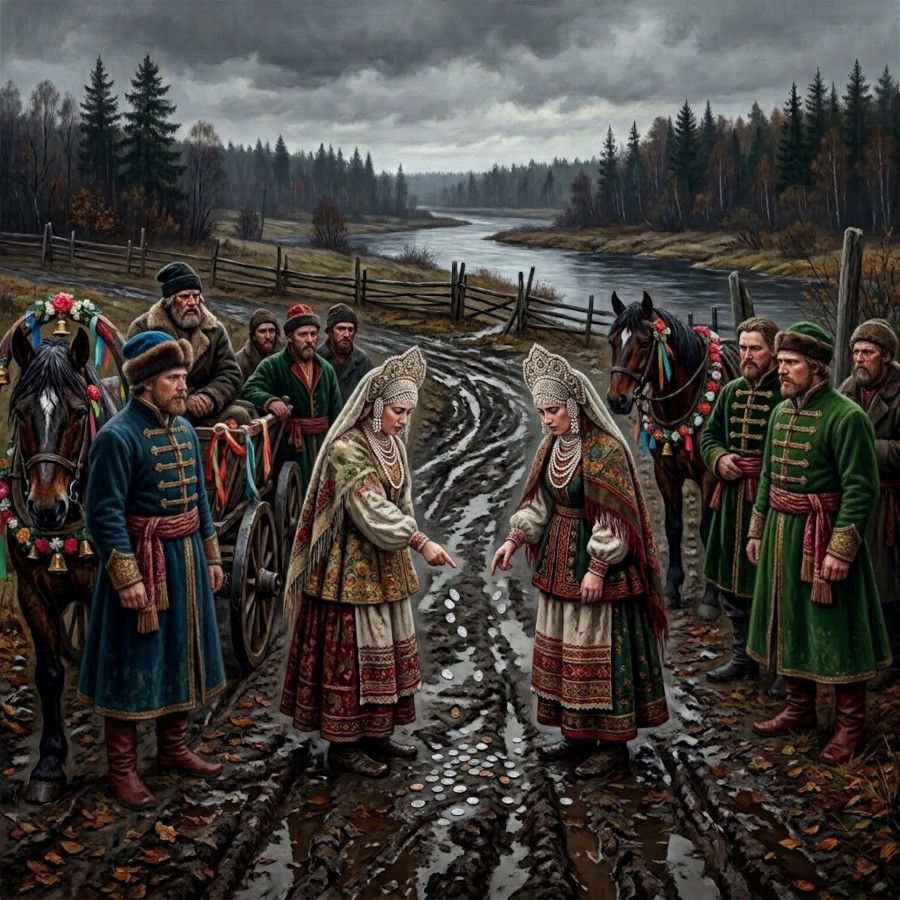
Yet the most dread and mystical peril is meeting another wedding train. The South Slavs and the Belarusians of Polesia believe that when two brides cross paths, one will inevitably strip the other of her *dolya* (allotted destiny) and lifespan. To prevent this spiritual hijacking of fate, Montenegrins abruptly turn the brides’ faces away from one another, while Kosovo Serbs cover them entirely. Bulgarians compel the young women to exchange iron pins, sugar, or coins that have first been laid upon the bare earth. In Rivne Polesia, both processions are required to halt, and the couples must kiss and bless one another to untie the lethal knot of their crossed paths.
To be continued…
ꏍꏍꏍꏍꏍꏍꏍ
In the logic of traditional myth, the road is never merely a backdrop for travel. It is a living, aggressive element that demands payment for every yard traversed. The wedding train operates like a heavily armed diplomatic mission: bribing dark waters with silver, shedding tears at the crossroads, and bargaining with surrounding spirits for the right to live. Man does not command this space—he merely treads its razor’s edge with exacting precision.
🗝 Even today, modern wedding motorcades blare their horns at intersections and bridges, as though attempting to drive off an unseen threat with aggressive noise. What other seemingly inexplicable road traditions, peculiar routes, or vehicle decorations have you noticed at weddings in your region, and how do you interpret this ancient need to “shield” the journey?
#folklore #ethnography #slavictraditions #weddingritual #folkbeliefs