

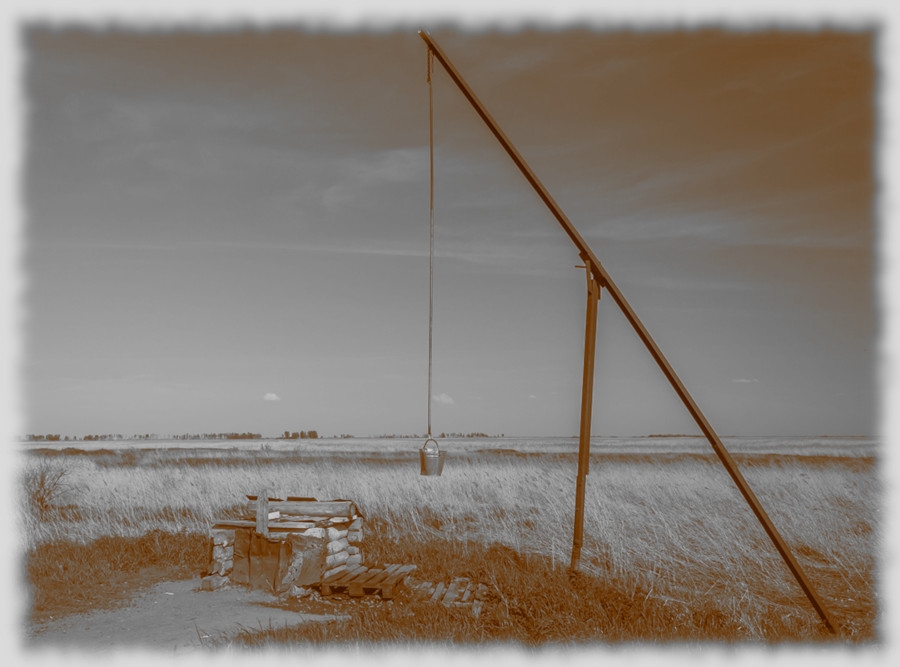
Meteorological Magic: The Well-Tomb and Makarka’s Tears
Greetings, seekers of ancient lore!
☀ When the sun scorched the fields and the heavens hung empty as a brass basin, our ancestors knew: it was time to turn to the water. Yet not simply to a river, but to a *kladez*—a well or a sacred spring.
🏞 The oldest East Slavic chronicles state plainly that the pagan Slavs were “bringing offerings to lakes and wells.” For centuries, the Church fiercely fought against this practice. An 11th-century Slavic translation of the *Oration of Gregory the Theologian* contains a unique interpolation absent in the Greek original: the scribe condemns anyone who “performed a *treba* [ritual sacrifice] at a spring, seeking rain from it.” Praying at wells was deemed a grave sin, equal to dark sorcery.
Yet how exactly did they “ask”? The ritual survived well into living memory in the remote region of Polesia.
🌧 In the village of Stodolichi, to bring about rain, little girls (*divochki*) were sent to the well-spring (*krinitsa*). Purity stood against drought. They were given blessed poppy seeds 🌺 to cast into the water, and then they would begin to churn and beat the depths with long wooden sticks.
😭 And at that moment, the central act unfolded. The girls had to wail, performing a funeral lamentation, “just as one would over a corpse.” They were not merely weeping—they were summoning. And we know whom.
They cried out into the depths: *“Makarko, little son, climb up out of the water, pour your tears across the holy earth!”*
💧 Consider the deep logic of this magic: rain is tears. For rain to fall, someone must weep. Who? The mythical drowned youth Makarka, the master of the watery abyss. In this rite, the well becomes his tomb, his resting place. By violently thrashing the water with sticks, they “awoke” and disturbed the dead; with their piercing laments, they forced him to weep. And his “tears” would spill down upon the parched earth as the long-awaited rain. This was not a humble plea—it was sheer ritual coercion.
ꏍꏍꏍꏍꏍꏍꏍ
Notice the essence of it: our ancestors did not pray for rain with meek humility. They demanded it, blackmailed the otherworldly, and deliberately tormented the dead to seize what was needed to survive. It is an aggressive magic born of desperation. Do you think this ancient principle—that the end justifies the means, even if it means disturbing the restless dead—has truly faded from our cultural psyche, or has it merely assumed a different mask?
For further reading on the subject: N.I. Tolstoy, *Essays on Slavic Paganism*.
#slavicmythology #slavicfolklore