
🏛 The Magic Circle of Time: How the Ancestors Saw the Year and the Day
Forget the four seasons. Or rather, forget the idea that they were always there. To the ancient Slav, whose entire existence was bound to the earth and the sun, the year was split quite differently—into two great “stations”: Summer and Winter. These were not merely “warm” and “cold.” They were two distinct worlds, two different “suns,” as the Bulgarians used to say: *lyatnoto slăntse* and *zimnoto slăntse* (the summer sun and the winter sun).
And this sacred divide had its own magical gateways, its own boundary stones.
The primary gates were the Annunciation (*Blagoveshcheniye*, March 25) and the Exaltation of the Cross (*Vozdvizheniye*, September 14). At the Annunciation, the earth “awakens.” Before this day, it was forbidden to “trouble” the soil—no plowing, no digging, not even driving a stake into the ground. It was believed that on this day, serpents and creeping things crawled out from beneath the earth, while the cuckoo flew back from *Iriy* (the warm spirit-realm). Summer begins. At Vozdvizheniye, the reverse took place. Every crawling creature retreated back into the earth for its winter slumber. The Ukrainians used to say that on this day, *”the earth shifts from summer into winter.”* The gates of Summer slammed shut.
Yet each of these two seasons possessed its own “crown,” its own sacred midpoint: for Summer, it was Ivan Kupala (June 24); for Winter, Christmas (or *Svyatki*, the winter tide).
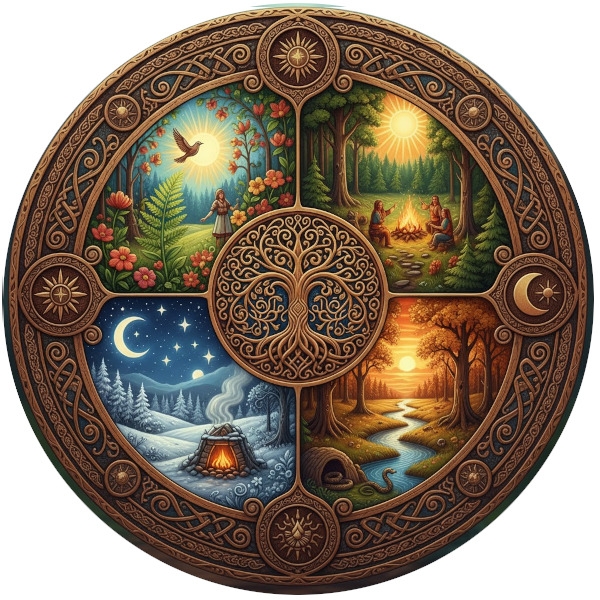
And here lies the true heart of temporal magic: this annual wheel is entirely isomorphic—it mirrors, point for point, the cycle of a single day.
See for yourself:
☀ Day (the light hours) is Summer.
🌑 Night (the dark hours) is Winter.
🌅 Dawn (the awakening) is the Annunciation.
🌇 Sunset (the descent into sleep) is Vozdvizheniye.
🌞 Midday (the zenith of light) is Ivan Kupala.
🌚 Midnight (the depth of darkness) is Christmas.
This cosmic blueprint explains why the most terrifying, “unclean” hour is not midnight itself, but the “dead of night” (*glupitsa*)—the hollow span between midnight and the first cockcrow. It is a precise reflection of the yearly cycle! The most demonic time of the year is never Christmas night itself, but the days that follow: the “Frightful Evenings,” the “Unbaptized Days” (*Nechisti Dani*), when the Christ Child is born but not yet baptized, and all manner of unholy spirits (*nechist*) crawl forth from the depths to run rampant across the mortal world.
Thus, within the minor wheel of a single day, our ancestors lived through the great circle of the entire year.
ꏍꏍꏍꏍꏍꏍꏍ
If a year is merely one grand day, where do you belong in this eternal cycle: are you a child of radiant Midday (Ivan Kupala), or an inhabitant of mysterious Midnight (Svyatki)? At what hour does your soul truly feel “at home”?
For further reading on this subject, see: N. I. Tolstoy, *Essays on Slavic Paganism*.
#slavicmythology #slavicfolklore