POLAZNIK Post 4/4
Echoes of Paganism in the Christian Calendar
🌅 Why Does the “Magic of the First Day” Still Work Today?
As we conclude our series on the Polaznik, let us look deep into the mists of time. This ritual is a textbook example of *dvoeverie* (dual faith) or, in scholarly terms, religious syncretism.
An ancient pagan rite tied to the winter solstice did not simply vanish with the rise of Christianity. Instead, it anchored itself firmly to the feasts of the saints.
How the gods took on new names:
⛪ Patron Saints. People began welcoming the Polaznik on the feast days of Saint Ignatius, Saint Lucy, Saint Thomas, or on Christmas itself. Yet the essence remained pre-Christian: the unshakable conviction that the Beginning determines the Whole.
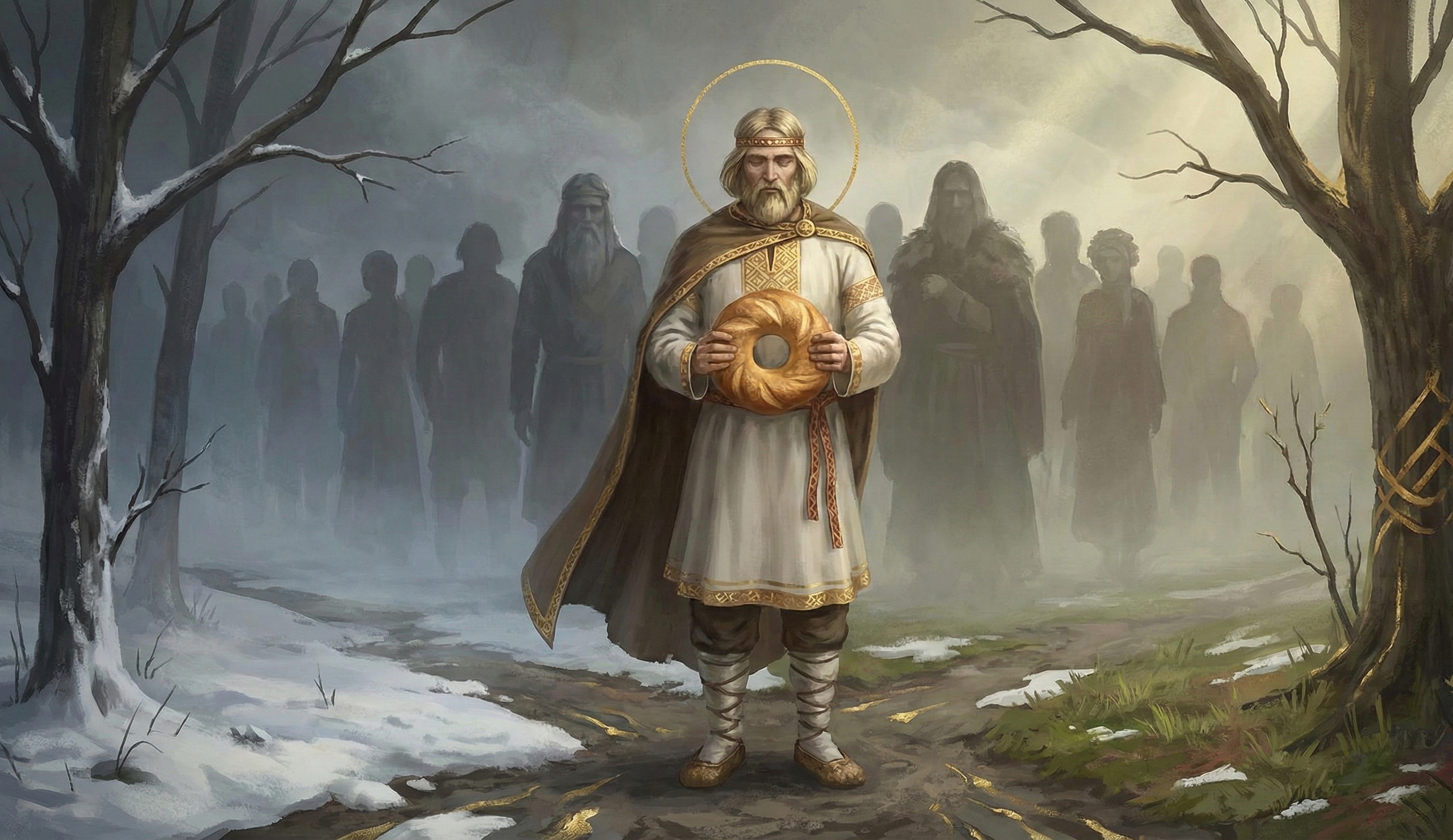
🥯 The Ring-Shaped *Kalach*. In Serbia, the Polaznik was gifted a ritual *kalach* with a hole in the center, which he would slip over himself. This was an ancient solar symbol—an emblem of the endless cycle of life, cleverly disguised as holiday bread.
✨ The Master as Theophany. The most archaic layer survived where the master of the house himself acted as the Polaznik. Stepping from the biting frost into the hearth’s warmth, he became a “god” bringing spring into the home. This is theophany—the divine manifested through a mortal.
Today, when we say “how you ring in the New Year is how you’ll spend it,” we are unconsciously repeating the prayers of our ancestors. The Polaznik never really left. He merely changed his name, living on as our faith in a brighter tomorrow.
A final thought: Magic is not about cheap parlor tricks. 🪄 It is the ability to perceive the sacred in the mundane: in the first snow, in the first guest, in the first spoken word.
Do you believe in the adage “as you begin the year, so it shall be”? Share your thoughts in the comments!
References:
🔸Usacheva, V. V. — “The ‘Polaznik’ Rite and Its Folklore Elements in the Serbo-Croatian Linguistic Area” (*Slavic and Balkan Folklore* anthology, 1978).
🔸Vinogradova, L. N. — “Incantation Formulas in Slavic Calendar Poetry and Their Ritual Origins.”
🔸Tolstoy, N. I. and S. M. — “Notes on Slavic Paganism: Rainmaking in Polesie.”
🔸Materials from the anthologies *Slavic and Balkan Folklore* (1978, 1984, 1989).