🕸 The Mycelium of Magic: What Connects a Croatian Demon to a Carpathian Dragon?
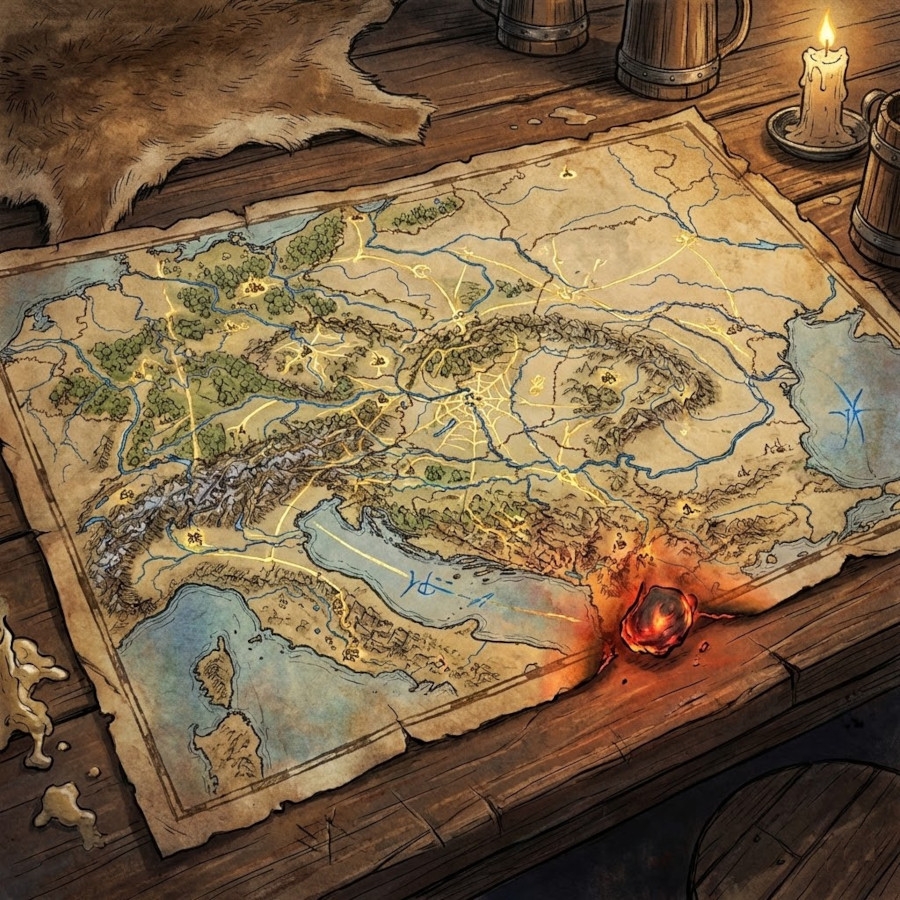
In previous posts, we explored the eerie demonology and protective wards of the Burgenland Croats. But the most striking truth about their culture is that they never forged these rituals in isolation. Ethnolinguists refer to such places as “island enclaves” or living time capsules. Peering into them reveals the invisible threads that once wove all of ancient Europe into a single mystical tapestry.
🐉 The Carpathian Trail: Serpent Riders
Remember that chilling storm-conjuring youth—the *garaboncijaš*? The Croats of Hungary inherited this figure from beyond their borders. It is a direct echo of grim Carpathian and Romanian legends telling of formidable sorcerers who subdue dragons with an enchanted bridle and take to the skies, wielding the weather like a weapon and casting ruinous hailstorms over their enemies’ fields.
🌱 The West Slavs: Sowing the Yuletide Crumbs
In our last discussion, we mentioned wild blooms springing from consecrated Easter crumbs. Yet this ritual was far from unique to the Croats. Further north, among the Western Slavs of Bohemia and the Slovak region of Gemer, peasants did the exact same thing—only using crumbs swept from the Christmas Eve feast. They believed that come spring, healing tansy or chamomile would take root in their soil. In the Croatian region of Međimurje, this sacred plant even retained its folk name: *koledno droptinje*—literally, “Christmas crumbs.”
🕯 The Slovenian Borderlands: Headless Phantoms
Close proximity to the Slovenes left an equally vivid mark. In Prekmurje—just as among the Burgenland Croat communities of southern Hungary—people lived in dread of will-o’-the-wisps. To them, these were no mere marsh lights, but gruesome, headless specters bearing a burning candle where their skull should be. Local lore claimed they were the damned souls of fraudulent land surveyors who spent their mortal lives cheating neighbors out of their rightful boundaries.
🌑 Echoes of the Homeland
Night demons such as the suffocating *mrak* were not born in exile; the Croats carried these memories with them through generations of migration. Tales of this sinister entity preying upon newborn babes in the dark can still be heard in their ancestral lands: across the Istrian peninsula and the highlands of Lika.
ꏍꏍꏍꏍꏍꏍꏍ
Academician Nikita Tolstoy once mapped out distinct “archaic zones” across Europe—sanctuaries where folk traditions remained untouched in their purest forms. Among them were the deeply archaic Polesia, the Russian North, western Bulgaria, central and northeastern Serbia, and Polish Kashubia. The enclaves of the Burgenland Croats belong in that very pantheon.
Folk culture is like a shattered clay vessel: unearth a shard bearing a warding spell in an Austrian village, and you will find it fits seamlessly into a Slovak ritual and a Romanian demon. Our world once shared a single, unified magical tongue.
👇 Have you ever noticed how your own grandmother’s eerie village tales, omens, or superstitions—whispers of the *leshy*, the evil eye, or the hearth-dwelling *domovoy*—suddenly echo the lore of cultures thousands of miles away? Have you ever felt the pull of this subterranean “mycelium” of folk mysticism that renders borders meaningless?
Further reading: A. A. Plotnikova, *Burgenland Croats of Austria, Hungary, and Slovakia: An Ethnolinguistic Study*.
#SlavicMythology #FolkBeliefs #SlavicFolklore #Ethnography #BurgenlandCroats #MythologyAndFolklore #TraditionalLore #PaganEchoes
[Localization Notes]
* “Градищанские хорваты” is rendered as “Burgenland Croats” (from *Burgenland* / *Gradišće*), the standardized English historical and ethnological term for this diaspora group.
* *Garaboncijaš* corresponds to the Hungarian *garabonciás* and Romanian *solomonar*, mythic wandering scholars and storm-callers; preserving the Croatian spelling retains local color while the context clarifies their nature as dragon-riding weather-sorcerers.
* *Koledno droptinje* relies on *koleda* (winter solstice / Christmas folk caroling cycles); translating its literal sense as “Christmas crumbs” ensures clarity while maintaining ethnographic authenticity.