To our ancestors, time was a dense, tangible matter that could be compressed, stretched, and wielded as a weapon. Today, we delve into the lore of extraordinary beasts and human beings whose power was forged in the singular moment of their birth.
Gather round for a tale of how “one-day” oxen and naked twins saved entire towns from the jaws of death.
—
### 🐂 Barnyard Special Forces: The Sorcery of the “One-Monthers” and “One-Dayers”
In the chapter under our lens, ethnolinguist Nikita Ilyich Tolstoy unveils an astonishing stratum of South Slavic beliefs (embracing Serbs, Montenegrins, and Bosnians). When a village was stalked by the Plague or the dreaded “Cow Death” (*Korovya Smert*), ordinary measures were useless. What was required was a force potent enough to tear through the very fabric of the mundane.
⏳ Born in the Same Hour
At the heart of this magic lies the concept of *jednoliki* (“the uniform” or “the identical”). These are beings brought into the world within the exact same span of time. It was believed their vital life force was not diluted, but rather concentrated and doubled.
Twin beasts wielded a profound, nearly sacred might:
* *Jednomesečići* — calves or oxen calved by the same dam within the same month (or lunar cycle).
* *Jednodanci* — “one-dayers,” born on the very same day.
In Serbia, people believed these creatures were living talismans. Black twin oxen (*crni volovi*) were treasured above all else. If none could be found in one’s own village, they were sought across entire provinces and bought at any cost — literally “worth their weight in gold.”
🛡 The Furrowing Rite (*Zaoravanje*)
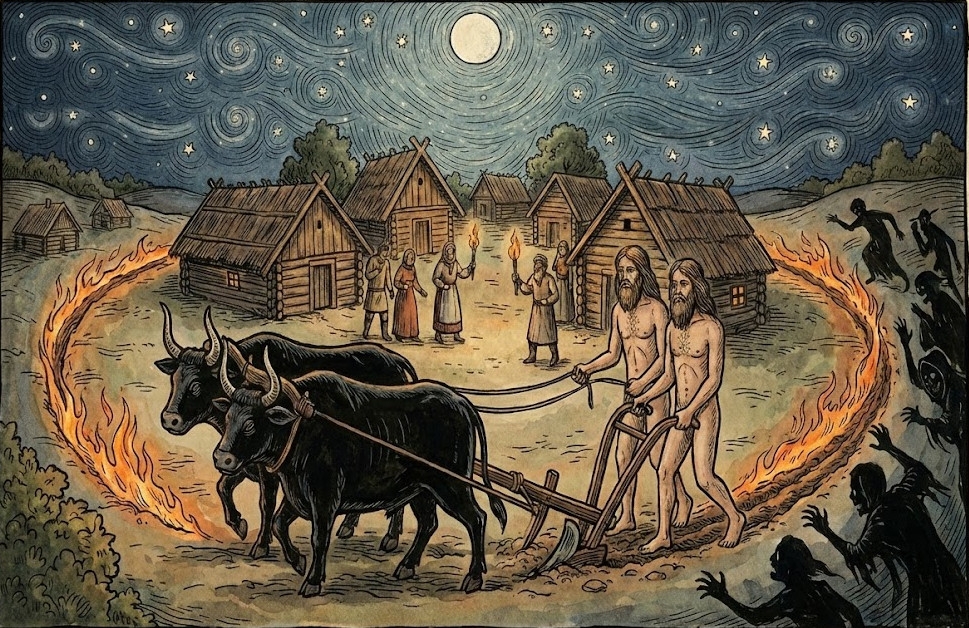
The primary mission of these oxen was to raise an impenetrable magical barrier. The rite itself read like the script of an archaic folk horror film.
In the dead of night, while the settlement lay asleep, a chosen group performed the ritual plowing of the village perimeter (*opakhivanie*).
1. Nakedness and Silence:
The participants (frequently twin brothers or widows) stripped stark naked. Nudity stripped away a person’s social markers, rendering them unrecognizable to demons.
2. The Black Twins:
The “one-dayers” were yoked to the wooden plow.
3. The Circle of Life:
Together, they carved a deep furrow around the village. This trench became an unbreachable wall against the Plague.
In eastern Serbia, the old saying ran: *”Kuda prođu volovi jednodanci, tuda bolest ne sme”* (“Where the one-day oxen pass, no pestilence dares tread”).
At times, the ritual grew even more complex: the participants had to leap over “living fire” (wildfire kindled purely by friction) or symbolically drag the Plague itself through a crawl-trench hollowed out beneath the exposed roots of an ancient tree.
🧵 The Northern Echo: The “Obydenniki”
Tolstoy connects this Balkan animal sorcery with the traditions of the Russian North. Among East Slavs (Russians and Belarusians), the idea of “compressed time” materialized not in beasts, but in man-made artifacts.
To halt a pestilence, village women would assemble to craft an object from scratch in a single day (*obydenno* — from dawn to dusk):
* An *Obydenny* towel (*rushnik*) — the flax was scotched, spun, woven, and draped upon a roadside cross, all between sunup and sundown.
* An *Obydenny* temple — in Medieval Rus, men could raise a wooden church in a single span of twenty-four hours! (In Vologda in 1654, the Church of the All-Merciful Savior was erected this way to break the grip of a devastating plague).
Both the southern *jednodanci* and the northern *obydenniki* are links of the very same chain. They represent humanity’s desperate bid to compress time, forging an artifact or a creature untethered from death. A thing wrought “outside of linear time” (within a single cycle of the sun) is deemed pristine, inviolate, and sacred.
👯 Human Twins: A Dangerous Bond
It was not only twin oxen that commanded awe; human twins (*blizanci*, *dvojci*) were likewise viewed as liminal beings walking the threshold between worlds.
On the one hand, they wielded healing powers (they were believed capable of curing back agony simply by treading on the sufferer’s spine).
On the other hand, their connection carried a sinister edge. It was believed that twins shared “a single soul divided between two bodies.” Should one perish, the death of the other was expected shortly after.
To sever this fatal cord, people placed *razryv-trava* (the legendary “break-iron herb”) into the deceased twin’s grave, or forced the surviving sibling to cast three coins into the burial pit with the incantation: *”Yours to you, and mine to me.”*
Tellingly, mothers of twins were strictly forbidden from eating “double-fruits” (fused cherries, apples, or plums) lest they conceive twins once more — a burden deemed far too perilous.
ꏍꏍꏍ
P.S. Notes from the Margins:
Curiously, in certain Serbian enclaves, it was believed that *jednomesečići* (children born in the same calendar month, particularly in March) possessed the sight to detect vampires invisible to ordinary folk. Meanwhile, high in the Carpathians, folk belief held that twins could command the skies, turning aside devastating hailstorms.
ꏍꏍꏍꏍꏍꏍꏍ
👇 Observe the underlying logic: our ancestors believed that an “emergency concentration of human and divine effort” (to birth in the same breath, or build entirely in a single day) generates a supernatural charge capable of defying Death itself. It is the conviction that a monumental feat of compressed time alters reality.
Do you think this ancient instinct still flickers within us? Could it be why we harbor such a strange kinship with “crunch time,” clinging to the subconscious belief that work hammered out in a single nocturnal frenzy right before the deadline carries an almost magical aura of triumph? 😅🔥
For a deeper dive into these rites, explore: N.I. Tolstoy, *Essays on Slavic Paganism*.
#slavicmythology #folklore #slavictraditions #ethnolinguistics #slavicpaganism #folkbelief #ethnography #slavicfolklore