

SPITTING IN SLAVIC TRADITION: PART 1/2
Today, we’re delving into something modern etiquette considers the height of vulgarity—yet our ancestors regarded it as one of the most potent magical tools in existence. Yes, we’re talking about spit! 💦
If you think spitting is merely uncouth, think again. In Slavic tradition, it was a universal “antivirus” against evil, a conduit for transmitting vital energy, and even… a secret culinary ingredient for spiritual protection.
Brace yourselves: things are about to get weird, but deeply fascinating!
💦 “Tfu on you!”: Spit as a Shield and Ward
In today’s world, spitting toward someone is a grave insult. In the world of our Slavic ancestors, it could very well mean: “I wish you well, and I am protecting you.” Spitting was an omnipresent apotropaic act—a way to ward off evil, the evil eye, and unclean spirits. But beware: spitting was a double-edged sword. It served both as a protective banishing agent and as a conduit for casting hexes.
🧿 The “Over the Left Shoulder” Ritual
To this day, many of us still spit three times over our left shoulder to keep from jinxing our luck. It’s an ancient reflex! The East Slavs did this at the mere mention of misfortune. Yawned? Spit, lest an imp slip into your mouth. Stepping out of the house? Spit to the side.
Our ancestors often sealed the act with spoken charms. Among East Slavs, a common phrase was: *”Tfu, so that no urok may strike!”* (where *urok* denotes a hex or the evil eye), while Slovenians murmured: *”Ne bodi ti urok!”* (“May it not become a hex!”).
In the Polissya region, a housewife afraid that a stranger might put the evil eye on her work (like weaving linen) would quietly spit in their tracks as they walked away. In Galicia, travelers observed an entire ritual: before embarking on a journey, one had to spit three times on the thumb of the right hand and trace a line across the forehead. Lost your way? Utter an incantation three times and spit thrice!
🐮 “Curses onto the Dog!”: Protecting Livestock
Livestock was treasured above all else, and saliva served as the primary spiritual antiseptic against unseen harm.
When bringing a newly bought cow into the barn, Poles would spit three times, reciting: *”Na psa uroki!”* (“May the hexes fall upon the dog!”). When leading a cow out to pasture or to market, a housewife would spit directly onto the animal’s head and wipe it with the inside hem of her shirt. Czechs and Slovaks likewise considered it mandatory to spit upon newborn animals.
Even fishermen and poultry keepers relied on this magic! In Polissya, women spat upon the first egg laid by a hen to ensure future clutches would be fertile. And if anyone dared step over a Polish fisherman’s rods, he would instantly spit over his left shoulder. What’s more, spitting was an immediate countermeasure against bad omens: if a crow cawed ominously overhead, you had to spit thrice—or spit on a stone and hurl it at the bird.
Yet, not all spit was protective. Slavs harbored a dread of the saliva of certain creatures. In Ukraine, folk belief warned that if a toad spat into your eye, you would go blind. In Poland and Bulgaria, a weasel spitting into a water jug was believed to turn the water into deadly poison.
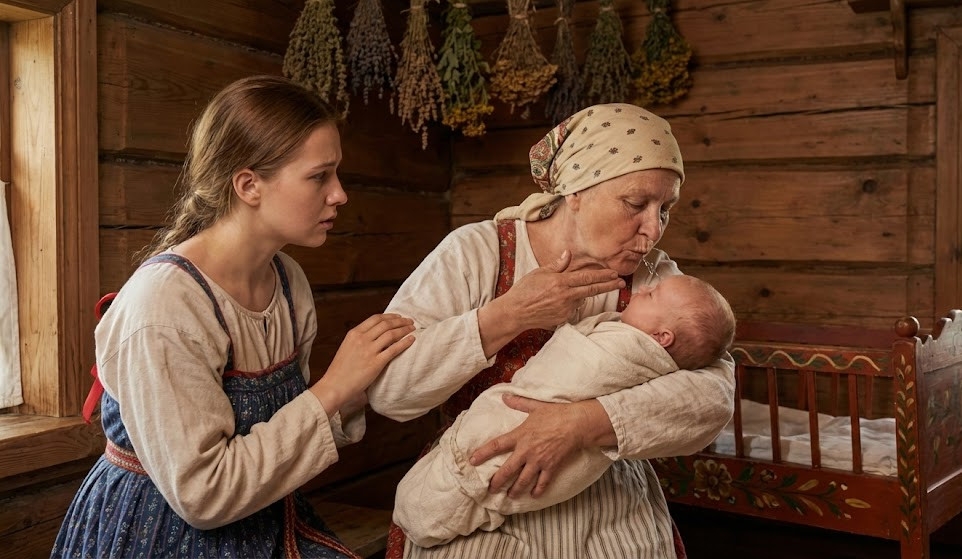
👶 Spitting in a Baby’s Face (Not for the Faint of Heart!)
Here is where a modern mother would faint on the spot. To protect an infant from the evil eye, visitors were expected to… spit on the child!
🔸 Slovakia: The first person to lay eyes on the newborn was expected to spit on them.
🔸 Serbia: A guest would do the same, adding the colorful, deceptive insult: *”Gad!”* (“Vile creature!”), intended to trick listening spirits into believing the baby was unwanted and worthless.
🔸 Western Ukraine: Here, guests were slightly more discreet—before glancing at the child, they would spit into their own pockets.
Mothers went just as far. In Belarus, after bathing a baby, the mother would kiss the infant and spit into the bathwater to cast out lingering evil. In Macedonia and Serbia, a mother would spit onto her palm or the underside of her skirt hem and smear it across the baby’s face and mouth.
Some went even further: to protect a newborn from *babitsy* (malevolent childbed demons), a woman would knead a small bread roll using her own saliva, bake it, and eat it while chanting a protective charm.
Yet danger lurked here, too. Macedonians believed that the *narechnitsi*—demonic spirits of fate—could spit directly into a nursing mother’s eyes to bring ruin upon her.
ꏍꏍꏍꏍꏍꏍꏍ
👇 Question for you:
Picture this: relatives drop by for a visit, and out of pure goodwill, they start spitting on your cat—or worse, on your newborn baby, yelling “Vile creature!” How would you react? Would you chase them out with a broom, or, honoring ancient tradition, politely offer your left shoulder? 😂
For a deeper dive into the subject, see: *Slavic Antiquities: An Ethnolinguistic Dictionary*, edited by N. I. Tolstoy.
#slavicmythology #folklore #slavicfolklore #slavictraditions #folkbeliefs #slavicpaganism #ethnography #folktraditions