
🧹 Feast with the Dead: Seeing Off the Sated and Spring Graveyards (Part 3)
The moment the nocturnal feast of the ancestors ends, the breached perimeter of the *izba* must be resealed. Leaving chthonic guests among the living is perilous, so the masters of the house proceed with a resolute, ritual expulsion. In the Grodno Governorate, the head of the family throws the doors open once more, places a harrow across the threshold, and vigorously sweeps every corner with a broom, banishing the unseen: *“Kysha, kysha, dushachki!”* (“Out, out, little souls!”). In the Gomel region, benches are shoved abruptly away from the table and water is sloshed across the floor right to the threshold, barring the spirits’ return: *“Shto ne daeli i ne dapili, to idzitse na papou dvor”* (“Whatever you haven’t finished eating and drinking, go finish it in the priest’s yard”).
🦅 Food for the Unseen
It is strictly forbidden for the living to consume the remnants of the night’s meal touched by the dead. The food is gathered from the table and cast back into the realm of nature: thrown beyond the gates facing the cemetery, tossed onto the roof, or carried out to the orchard beneath an apple tree for the sparrows (*verabeyki*) to peck away—for birds serve as the corporeal vessels of souls. If the family commemorates someone who drowned (*taplenik*), the scraps from his ancestral saucer are carried out and cast directly into running water. In certain villages of Lelchytsy, the memorial food is burned on split logs, rising back to the spirits with the smoke.
🌿 The Spring Threshold
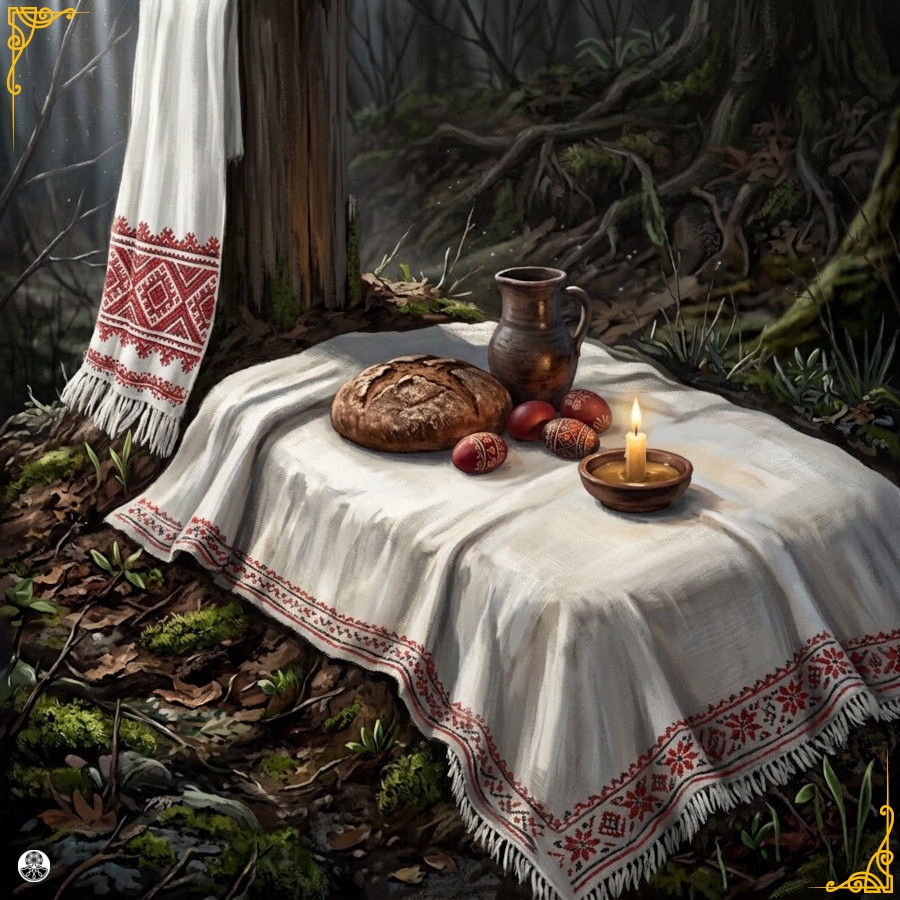
The final phase of this spatial covenant takes place in spring—on Radonica or Provody (the Nav Easter). During these days, the graveyard temporarily becomes an inhabited, living space. Graves are dusted with clean sand and draped with fresh tablecloths, transforming earthen mounds into banquet tables. Relatives gather round and beckon their forebears: *“Idi z nami vecherat”* (“Come sup with us”). At the foot of the cross, wine and honeyed *syta* are poured out three times, leaving a loaf of bread in offering.
With this shared meal, the living symbolically escort the departed—who have been “visiting” the villages—back to the *pogost*. As autumn draws near, the memorial rites gradually fade, and the souls withdraw from human-tamed lands into the deep, untamed wild, which merges invisibly at its furthest borders with the realm of the dead. There they shall dwell in the dark until the hour their descendants summon them once more to a ritual feast within their homes, and the eternal cycle turns again.
ꏍꏍꏍꏍꏍꏍꏍ
The traditional cycle of remembrance is not an endless lament; it is a strict seasonal pendulum. The living deliberately open the floodgates of the cosmos, inviting chthonic forces into the hearth to seal a dietary pact, only to ruthlessly purge the home afterward and drive the dead back to their resting grounds. This spatial cadence preserves cosmic balance: the ancestors receive warmth and their rightful portion, while the living secure a fertile harvest and an ironclad guarantee that the two worlds will never bleed into one.
🧹 Many of us still carry painted eggs, pastries, or sweets to the graves of our loved ones. How do you understand this deep, instinctive urge to physically “feed” the departed, and what spring cemetery rites are still observed in your family?
For further reading: M. A. Andryunina, *“Symbolic ‘Feeding’ of the Dead: A Spatial Characterization”*
#folklore #ethnography #slavictraditions #ancestorworship #radonitsa