
🌾 Bloodline Engineering: The Survival Reserve (Part 3)
In the unyielding architecture of the Slavic clan, children and younger siblings were never merely a source of joy; they were a strategic reserve for survival, a physical investment in tomorrow. Their premature death was met not just as a devastating personal grief, but as a catastrophic rupture in the very machinery of continuity, leaving the elderly defenseless before destitution and the dark void of Nav—the realm of the dead.
🌱 The Gentle Successor
In a peasant household, a son was the future master, the breadwinner, and the sole guarantor of a peaceful old age. In North Russian laments, he was explicitly mourned as the *smenushka-nadeyushka* (“little hope-and-successor”) or *lyogkaya peremenushka* (“the gentle relief”), and in Ukraine as *moya pereminochka* (“my sweet changing-of-the-guard”). The loss of a young man violently severed the natural flow of time. Dirges likened him to an “unripe berry” or an “unblossomed apple sapling.” Over his body, weeping parents cried out against the collapse of life’s sacred order (*uryad*): his sacred duty was to feed them in their winter years, and when the hour came, to lay their kin-bones to rest.
🧶 The Delouser and the Helpmate
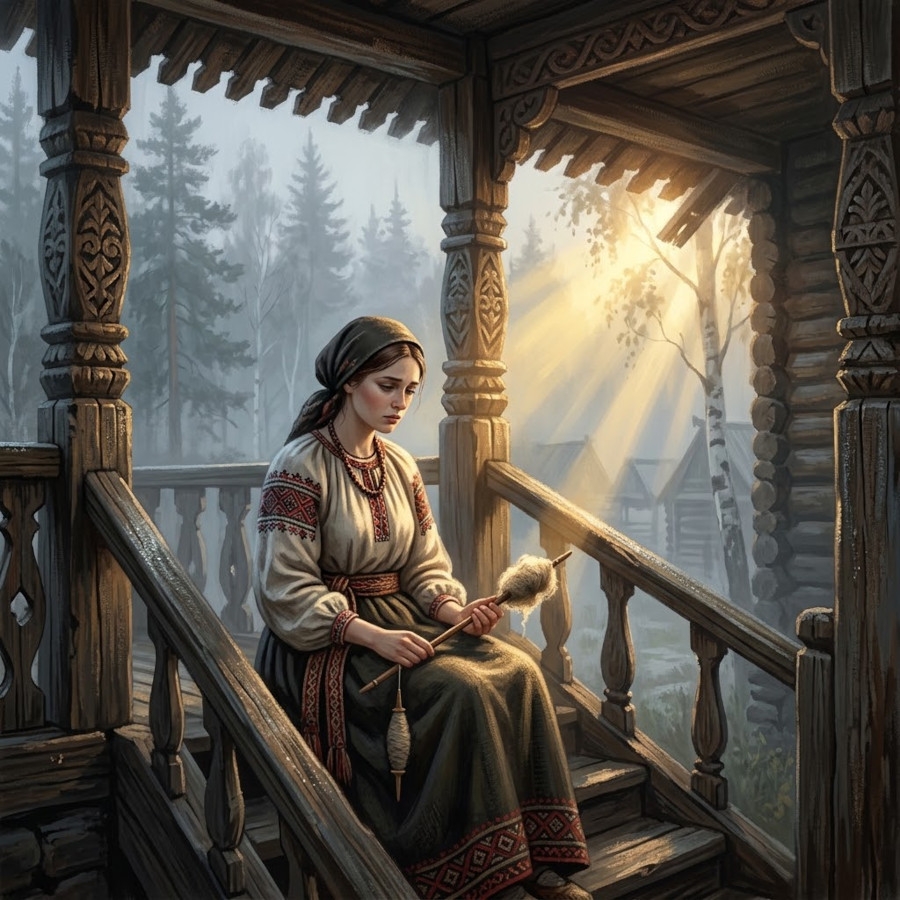
A daughter was woven into the rhythm of daily toil from early childhood. In Ukrainian and Belarusian traditions, her memory was often stripped of fairy-tale gilding—she was relentless, indispensable labor. Over her lifeless form, a mother would sob an endless ledger of uncompleted tasks: her girl had been the *shvachechka* (the little seamstress), the *pryashechka* (the spinner), the *pomitushko* (the sweeper). Ukrainian laments preserve a piercing epithet: *moya iskal’nitsa*—”my little searcher.” She was the one who combed through her mother’s hair to pick out lice—an intimate, quiet chore entrusted only to the closest female kin, embodying total physical tenderness and spiritual devotion. North Russian laments, by contrast, frequently envisioned the deceased daughter as a folkloric tsarevna in splendid robes, kept unburdened by rough labor and seated in the *krasny ugol*—the sacred icon corner of the izba—signifying her cherished status as a high-born, beloved bride-to-be.
🛡 Keeper of Maiden Freedom
The elder brother naturally stepped into the protective mantle of the father. In northern traditions, he stood as the bedrock of defense for his orphaned sisters. For an unmarried girl, he was the *sberegatil devich’ey volyushki*—the “guardian of maiden freedom,” the shield of her honor and standing within the village until her wedding day. He was also her *povoznichek*—the driver who harnessed the cart to carry his sisters to village festivals and ring-dances. When the household head fell, the elder brother seized the dropped banner of the *bolshak* (the clan patriarch), binding the scattered orphans into a single clan fist so they would not be cast out, defenseless, into the cold mercy of the “alien outside” (*chuzhaya chuzhina*).
ꏍꏍꏍꏍꏍꏍꏍ
Under the ancestral *uryad*, a child never belonged purely to themselves. They were a living link in an unbroken chain of obligation, where the debt owed to forebears was paid in relentless sweat for the living elders. To lose a successor was to shatter that chain, condemning the entire lineage to decay and social death—for in a world of raw physical survival, an elder who could no longer work without a young hand was doomed.
🗝 In traditional folk culture, children were rapidly transformed into full-fledged laborers and the family’s primary bulwark. At what point in modern history do you feel we completely abandoned this view of children as “relief shifts” and indispensable workers? And in what subtle, everyday rituals do you still see echoes of this rigid ancient hierarchy between elders and youth?
For further reading: L. N. Vinogradova, *“Man in the Role of the Model Family Man (Based on East Slavic Laments)”*
#folklore #ethnography #slavictraditions #family #laments