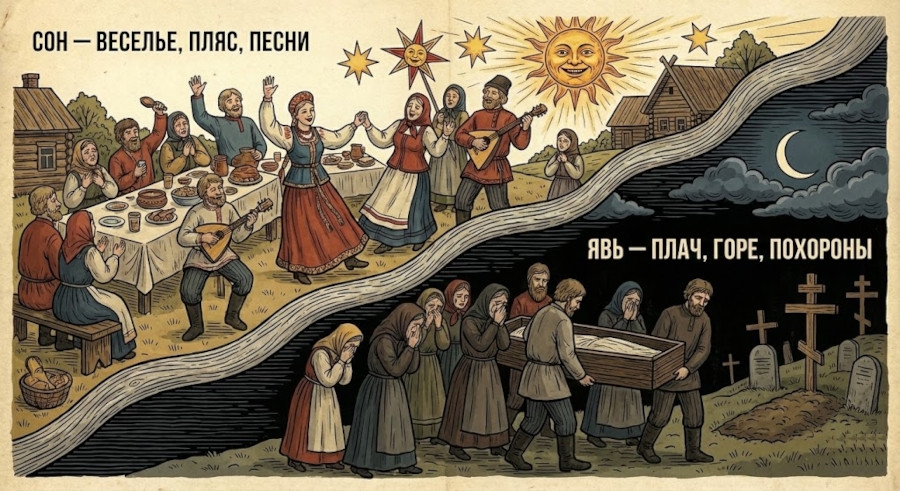
For our ancestors, sleep was a “little death”—a journey of the soul into the Otherworld. And the realm beyond has its own laws, governed primarily by the principle of the mirror, the inversion.
Here is how the Slavs, from Poland to the Urals, deciphered their nocturnal visions.
ꏍꏍꏍ 🔄 The World Inside Out: The Principle of Inversion ꏍꏍꏍ
The primary rule of folk dream interpretation was simple: “In dreams, everything is reversed.” The afterlife mirrors our reality; thus, what appears as joy over there inevitably turns into sorrow over here.
🎭 Laughter and Tears
If you find yourself singing, dancing, or laughing in a dream, beware of impending misfortune.
In Polesia, an old saying warns: *”Spevats’ — plakats’ budzesh”* (“Sing now, and you will weep later”).
Merriment in dreams was perceived either as the torment of a wandering soul on the other side or as an omen of grief in the waking world.
👰 A Wedding Is a Funeral
This is perhaps the most chilling and enduring symbol. Weddings and funerals represent the two major rites of passage in life, sharing the same ritual architecture: ritual washing, new garments, a feast, and lamentations. Consequently, in the dreamscape, one readily replaces the other.
To witness a wedding (*vyaselle*, *svadba*) portends a funeral.
Dancing with a bride or groom foreshadows death.
A bride’s white gown is nothing less than a shroud.
In one Polesian folk narrative (*bylichka*), a mother dreamed of her daughter’s church wedding, only for the girl to pass away three days later. *”Vyaselle — to umirushchi”* (“A wedding means the dead”).
ꏍꏍꏍ 🏠 The House as a Coffin ꏍꏍꏍ
In traditional cosmology, the House and the Coffin are identical. Folk riddles often refer to a coffin as a “new house with no windows and no doors,” or simply call it a *domovina* (from *dom*, house). Thus, any construction work in a dream signifies preparations for crossing into the other realm.
🏗 The House of Eternity
* Building an izba (*khatu stavits’*) means building your own coffin.
* Carpentry and the thud of an axe signal the hewing of a *domovina*.
* Whitewashing walls foretells death (for white was historically the color of mourning and death among Slavic peoples).
🧹 The Threshold and the Sweepings
If you dream of sweeping the floor and brushing the dust over the threshold, you are sweeping out a living soul.
If the *matitsa* (the central ceiling beam, or *svolok*) collapses, or if a window falls out, the master of the house—the pillar of the family—will perish.
Tellingly, in ancient custom, the dead were often carried out not through the door, but through a window or a deliberate breach in the wall; thus, cutting a new window in a dream is an unmistakable harbinger of doom.
ꏍꏍꏍ 🦷 Teeth Are the Kin ꏍꏍꏍ
This symbol is universally recognized and remarkably consistent throughout the Slavic world. A person was seen not as an isolated individual, but as an organic part of the *Rod* (the ancestral clan). The physical body represented the family tree.
Consequently, the loss of teeth (*zuby*, *zoub*) was interpreted quite literally as the loss of a kinsperson.
* A tooth lost “with blood” meant the death of a blood relative (father, mother, child).
* A tooth lost “without blood” signified the death of a distant relative, in-law, or neighbor.
* A blackened or aching tooth forewarned of an illness afflicting a loved one.
* A loose tooth meant a kinsperson was “tottering” (falling ill), though they might yet pull through.
ꏍꏍꏍ 🌱 Earthly Labors ꏍꏍꏍ
One might wonder: what could be sinister about harvesting? Yet to a peasant, tearing anything from the soil symbolized severing the tether to life.
* Digging up potatoes or gathering mushrooms portended a corpse (through their direct association with dirt and the grave).
* Pulling flax or hemp meant death (these plants run deep; to uproot them is to extinguish life).
* A lush, blossoming orchard was a favorable sign of vitality, whereas withered trees or a fallen forest presaged pestilence and death.
ꏍꏍꏍ
P.S. Extra notes from the field:
Curiously, several omens involved animals: a white horse was widely seen as a messenger of death (an angel of death), while oxen (bulls) presaged grueling labor or a funeral—for it was by oxen that coffins were traditionally carried to the graveyard. Furthermore, murky water (*kalna voda*) unfailingly foretold sickness, whereas clear water promised good health.
ꏍꏍꏍꏍꏍꏍꏍ
👇 Notice the underlying logic: these are not mere superstitions, but a coherent “language of metaphors.” The subconscious of our ancestors spoke to them through the everyday reality they knew: House = Coffin, Tooth = Kin, Wedding = Transition. It was a stark yet intuitive early-warning system, where the Otherworld mirrored our own in reverse.
Do you think this ancient code still echoes today? Have you ever had these archetypal dreams—of losing teeth or building a house—before major life events, or do our modern dreams speak only in the vernacular of offices and gadgets? 🛌💭
For further reading on the subject, see: N. I. Tolstoy, *Essays on Slavic Paganism*.
#slavicmythology #folklore #slavicfolklore #folkbeliefs #slavictraditions #slavicpaganism #ethnography #tradition