
☀ Four Guardians of the Izba: The Masculine Pole (Part 1)
A traditional East Slavic dwelling is far more than mere shelter from the elements; it is a rigorous diagonal microcosm, mapped out into distinct spheres of influence. The sacred epicenter of this universe is the front corner—known as the *krasny ugol* (“beautiful” or “red corner”) in Russia, *pokut’* in Ukraine, and *kut* or *pokuts’* in Belarus. Invariably oriented toward the east or south—the domain of the rising sun—it stands as a territory of absolute order, arrayed against external chaos.
🧔🏻 The Master’s Axis
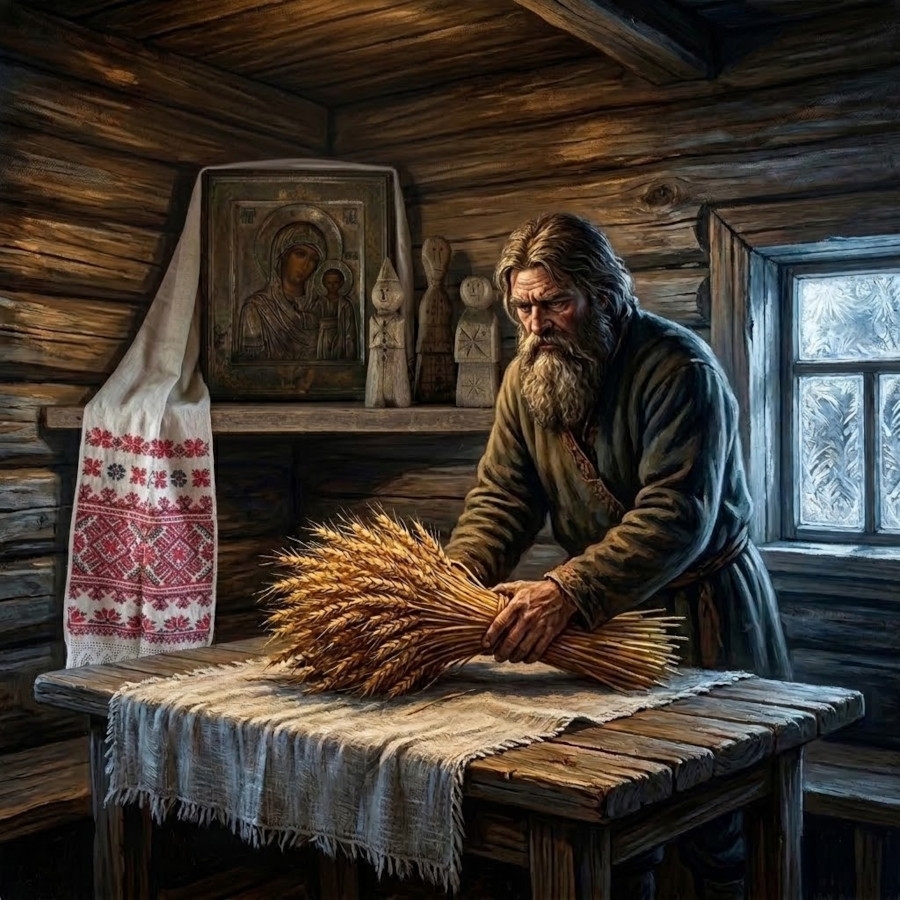
The *krasny ugol* is indissolubly linked to the household’s senior male—the *khozyain* (master of the house), who personifies the living bond with the ancestral protector. All social and magical gravity of the kin gravitates toward this single point. In Polesia, a midwife would bury the placenta of a newborn boy specifically beneath the *pokut’* or under the family table, ensuring he would grow into a true master and remain rooted to the ancestral home; a baby girl’s afterbirth, by contrast, was buried beneath the threshold. Outsiders were sifted along this very axis: in the Kostroma and Vologda lands, honored and invited guests were seated in the front corner (*sutki*) and hailed as *sutnye gosti* (“honored guests”), while uninvited visitors were kept stranded by the door—the *kutnye gosti* (“fringe guests”).
🌾 Gold of the Kin
It is here that the dwelling intersects with the Divine. Upon the *bozhnitsa* (the icon shelf), resting beside holy icons, the family preserved their most essential talismans of survival: double-eared stalks of grain (*sporina*, the harbinger of abundance), dough crosses baked for Mid-Lent (*Sredokrestie*), and withered remnants of blessed Trinity greens. In the Vologda and Arkhangelsk regions, the final harvested sheaf—ceremonially known as the *boroda* (“the beard”)—was solemnly placed here. During the winter Yuletide (*svyatki*), the master of the house would personally carry hay and sheaves of grain (*didukh*, or *snopik zhyta*) into the corner to safeguard future harvests—*”shchob zbizhzhya rodylo”* (“so that the grain may yield”), as they say in Volhynia.
🚫 The Strict Order
Proximity to this sacred epicenter demanded unyielding discipline. Sleeping with one’s feet pointed toward the front corner was considered a grave sin. The water used to ritualistically wash the icons before major feasts had to be poured out exclusively beneath the exterior foundation of the *krasny ugol*. Even seemingly innocent objects underwent severe scrutiny: while in Ukraine empty, blown *pysanky* (ornamented eggshells) were often suspended in the corner, the practice was sometimes strictly forbidden out of a lingering dread that during thunderstorms, the Devil himself might seek refuge inside the hollow shell.
To be continued…
ꏍꏍꏍꏍꏍꏍꏍ
In the Slavic architecture of being, the front corner is not merely a place of prayer, but a spiritual and social monolith. Here, the authority of the elder male physically fuses with ancestral benediction and divine might. By holding this pole, the master of the house quite literally anchors chaos, preventing the entropy of the outside world from tearing the fragile fabric of the home apart from within.
🕯 Cast your mind back to the layout of your grandparents’ homes: what objects or unspoken rules defined the most “honored” place in the house, and how were seats distributed around the table during great family gatherings?
#ethnography #slavictraditions #folklore #redcorner #traditionalhome