
SERBIAN WEATHER MAGIC: Part 3/3
The Celestial Watch: Zduhaći and the “Devil’s Voivodes”
Hail, kin! This is the final chapter of our Balkan chronicle. We have spoken of how common folk defended their fields. But there were those for whom war against the skies was destiny. In the rugged mountains of Serbia and Montenegro lived people whose souls knew no peace.
These were no fairy tales. For the villagers, this was as real as the sunrise.
😴 Zduhaći: Men with the Shadow of a Dragon
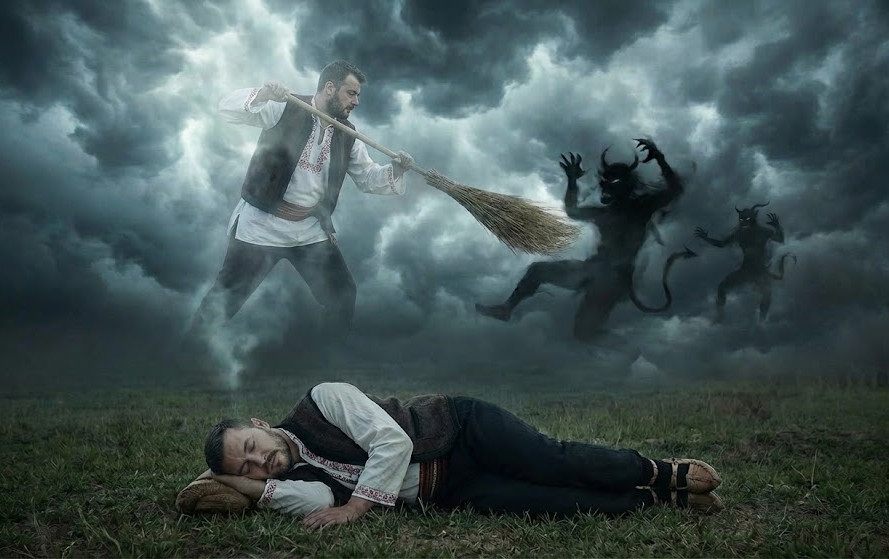
In Montenegro and Herzegovina, people knew: walking among the shepherds and plowmen were the *zduhaći* (or *vetrogoni*—the “wind-chasers”). By day, such a man seemed unremarkable—often sullen, brooding, perpetually drowsy. But when the skies turned to lead and the gale gathered, his face changed. He heard the call. The *zduhać* would collapse wherever he stood, sinking into a death-like slumber. He must never be awakened—his body was left empty, and should it be disturbed, his soul might never find the way back.
While the flesh slept, his spirit-double surged up into the storm clouds. There, a titanic battle unfolded. The *zduhaći* of one village formed warbands to clash against foreign *zduhaći*. In the heavens, they battered one another not with swords, but with whatever fell to hand, magnified to colossal proportions: uprooted ancient oaks, millstones, massive barrels. Yet their deadliest weapons were brooms and shovels. Whoever managed to wrest a broom from an enemy in this astral brawl carried off good fortune and the harvest for their own village. Upon waking, the *zduhać* often could not even stand—his entire body bruised and aching, as though he had spent the whole night hauling stone.
👹 Trivun, the “Devil’s Voivode”
In Eastern Serbia, the “cloud-chasers” (*gradobranitelji*, or hail-defenders) fought wide awake, throwing themselves into a battle trance. Trivun Selenić from the village of Kamenica became a legend. The villagers called him the “Devil’s Voivode” (*Đavolji vojvoda*). At the first sight of a storm cloud, he would bolt into the fields, trembling violently, his eyes rolling back into his head. He bellowed eerie, rhythmic commands into the sky in a language no one else understood: *”Raviše đaviše, naviše, kuriše!..”* He did not plead. He commanded demons. Sweeping his arms through the air, he wheeled celestial battalions: “To the right! Fall back, to the Danube!” And the clouds obeyed their general.
🏃♂️ The Sacred Madness of Nikola
Another guardian, Nikola Stojković, fought differently. At the first roll of thunder, he would tear off his cap—a sign of total surrender to the unseen forces—and charge straight toward the tempest, shredding his clothes and skin against the briars. He hurled crumbs of the Christmas bread (*česnica*) into the sky, and standing beneath the deluge, carried on a dialogue with the spirits of the hanged, alternately begging them and threatening them in the name of God.
💃 Padalice: The Soul Beyond the Body
The women were no less formidable. The *padalice* (women afflicted with the “falling sickness,” or epilepsy) were revered as exceptionally powerful protectors. A seizure during a storm was seen not as an ailment, but as the moment of clash: their souls took flight to lock horns with the *halas* (the storm demons). Meanwhile, the seeress Stana Tomić simply stepped out onto her threshold and talked to the sky as though scolding a bad neighbor, discerning the specific dead souls driving the storm: “Hey, Radomir, turn your horses back! No feast is laid for you here!”
These people were the living shield of the community. Outcasts and the chosen all at once. Folk avoided them, whispering of sorcery, yet come harvest time, it was to their doorsteps that the first sheaves and finest offerings were brought. For everyone knew: while the village slept, they were fighting in the heavens for every single ear of grain.
ꏍꏍꏍꏍꏍꏍꏍ
👇 The phenomenon of the *zduhać* describes a person with hidden depths: outwardly quiet, lethargic, and unassuming, yet holding a wild, elemental power that awakens only in the hour of danger. Have you ever crossed paths with such “sleeping volcanoes” in real life—people who seem completely passive in daily life, but when crisis strikes, step up and take control of the chaos while everyone else panics? Or perhaps you recognized yourself in this description?
For further reading on the topic, see: N.I. Tolstoy, *Essays on Slavic Paganism*.
#slavicmythology #slavicfolklore