
🐁 The Grim Compact: Warding Off Subterranean Vermin (Part 3)
The battle for a bountiful harvest and domestic peace is not fought solely against wolves and bears. A threat no less chthonic—and often far more insidious—creeps from below: the subterranean and household vermin, the mice, worms, and fleas. Their terrifying power lies in their multitude. To stem this living tide of decay, the Balkan Slavs raised defenses woven from incantations and unyielding spatial taboos.
🌾 The Mouse Quarantine of Mistrovdan
The day following St. Demetrius’ Day (November 8), as the earth braces for winter, marks the arrival of Mouse Day. The holiday bears a blended name—*Mistrovdan* or *Mištrovdan*—phonetically weaving the name of St. Nestor (November 9) with the Slavic *miš* (mouse). On this day, a merciless embargo is placed on anything the sharp-toothed intruders might gnaw. In the village of Strnovac, the matriarchs put it plainly: *“Не вадимо жито, не одимо во амбар. Не се сее жито… не пегламо”* (“We do not take out grain, we do not enter the barn. We do not sow grain… we do not iron”). Even opening linen chests is strictly forbidden. The household falls completely still, desperate not to provoke the destructive elements, deliberately stripping them of any contact with human belongings.
🧹 A Cast Lot
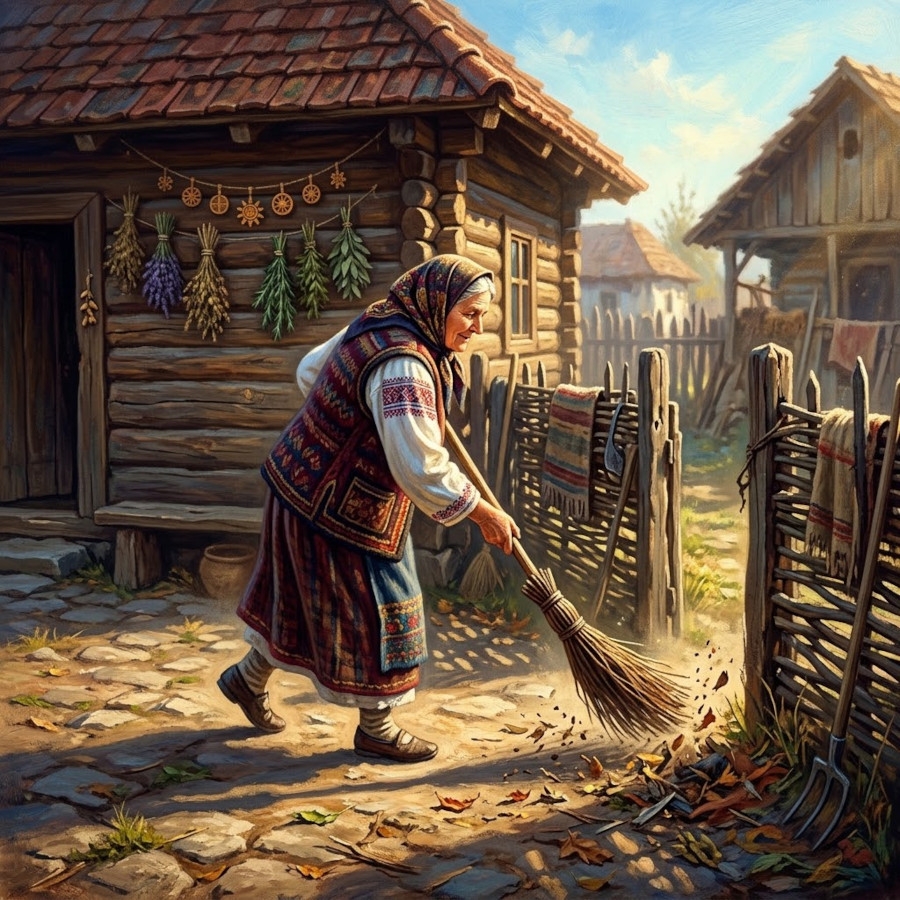
Household parasites like fleas are banished through more aggressive means: the spatial transference of defilement. On the morning after Christmas, a housewife in the village of Pelince sweeps her home with utmost care, steps out onto the terrace, and shouts across the fence toward a neighboring yard, calling out their name: *“Буви носи на комшију тога”* (“Carry the fleas to neighbor so-and-so!”). Tossing the unwanted—be it weeds or biting pests—onto another’s land is an ancient method of passing the blight. By cleansing their own threshold, the caster redirects the malevolent affliction to wherever defenses are weakest.
🔥 The Magic of the Sealed Word
A distinct ritual order is observed when dealing with worms, whom folk tradition considers direct kin to snakes due to their appearance and writhing gait. In the village of Mlado Nagoričane, on St. Barbara’s Day, villagers boil a mash of corn and wheat (*мешано: и пченка, и пченица*) meant to last for three full days. For the duration of those days, lighting a fire beneath the cauldron is an absolute taboo. The secret lies in the magic of language: the Macedonian verb *vrie* means both “to boil” and “to swarm / teem.” Peasant logic dictated: if you *boil* food, the earth will begin to *teem* with worms and creeping horrors. By placing an embargo on the word-action, humanity effectively arrests the breeding of the subterranean threat.
ꏍꏍꏍꏍꏍꏍꏍ
In the folk consciousness, warding off agricultural and domestic pests was never mere pest control; it was an intricate spatial and linguistic gambit. By sealing a quarantine around the granary, casting curses over the garden wall, or banishing dangerous trigger-words from speech, our ancestors carved an absolute sanctuary around their homes—a realm where the immutable laws of ritual proved far stronger than any lock and key.
🗝 How do you explain the enduring power of domestic superstitions, like the taboo against “taking out the trash after dark” or the dread of speaking ill omens aloud? In what modern rituals do you still catch glimpses of this ancient quarantine?
For further reading on the subject, see: A.I. Chivarzina, *“The Kumanovo Region at the Crossroads of Balkan-Slavic Traditions: Rites of Banishing Creeping Vermin and Wild Beasts.”*
#ethnography #folklore #slavicmythology #balkans #wards #traditionalbeliefs