🕯 Feast with the Dead: The Ransom Share and Bread in the Pokut (Part 1)
In the traditional worldview, death is not the cessation of existence, but an arduous physical transition requiring colossal resources. The moment a person draws their last breath, a strict spatial ritual (*uryad*) begins: a glass of water and a piece of bread “for the soul” are immediately placed beside the departed. While the body still lies in the izba, its unseen essence already hungers and thirsts. Here, food is no symbolic gesture of remembrance; it is dense, vital matter needed to sustain strength before the crossing into the “other world.”
🍞 The Burning Loaf
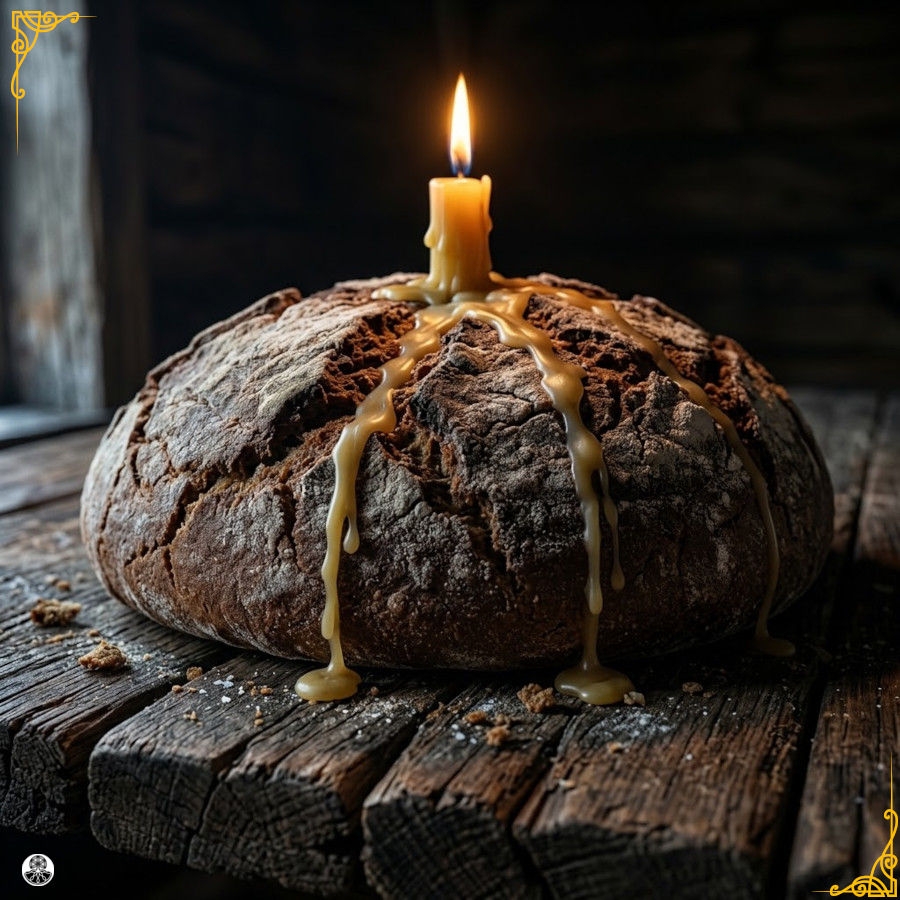
The house’s center of gravity shifts to the sacred corner (*pokut’*) or to the table beside the corpse. In the Smolensk region, the instant someone gives up the ghost, a round loaf of bread is placed upon the table, with a lit candle thrust directly into its crust. In Polesia, every mourner coming to pay their respects is bound to bring a *gostinets*—kalach bread, sweets, or lump sugar—and leave it upon the window ledge or the table. This is no hospitality meant for the living, but a stern material levy: a parcel that the newly departed will deliver to ancestors waiting on the other side, proving their standing and substance in the realm beyond.
🪙 Payment for the Khata
Yet a simple offering is not enough—the dead retain full claim to their share of earthly property. If it is not yielded willingly, they will take it by force. In the Arkhangelsk region, bread is laid directly into the coffin while reciting the formula of partition three times: *”Here is your share, here is your half.”* Fail to do this, and the deceased will “take their due”—a milk cow will vanish from the pasture, or another calamity will strike. In Rivne Polesia, this logic of ransom turns even grimmer: coins are hurled into the open grave with the words, *”Na tobi platu za khleva i khatu”* (“Here is your payment for the barns and the house”). The dead are settled in full, ensuring they can never reproach the living for inheriting an entire estate while leaving them with nothing.
To be continued…
ꏍꏍꏍꏍꏍꏍꏍ
Slavic funeral rites lay bare a chilling yet impeccably fair legal mechanism of antiquity. The living do not merely mourn; they engage in tense property negotiations with the otherworld, securing their own safety and severing any posthumous claims the deceased might hold over the house and livestock through precise transactions of bread and coin.
🗝 Today, the custom of leaving a shot of vodka crowned with a slice of bread, or scattering sweets across a grave, is often seen as a mere gesture of remembrance. Think back to your own family traditions: how was the food left over from a wake or memorial meal treated? What strict taboos, anxieties, or prohibitions tied to this “dead food” have you encountered yourself?
#folklore #ethnography #slavictraditions #funeralrites #folkbeliefs